


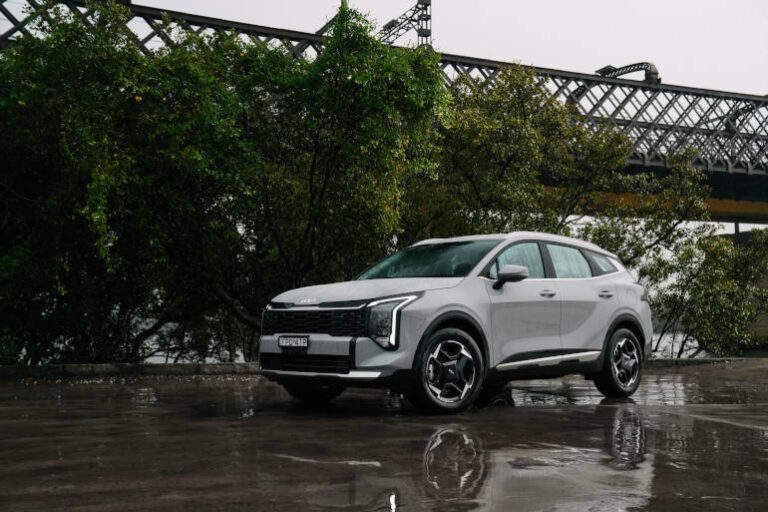
Kia has confirmed pricing and specifications for its upgraded 2026 Sportage line-up, with the big news being the addition of all-wheel-drive hybrid variants — a move that signals the increasing importance of low-emission vehicles as carmakers prepare for Australia’s New Vehicle Efficiency Standard (NVES).
The expanded hybrid range — now available in both front- and all-wheel-drive SX and GT-Line variants — arrives as Kia and other brands face mounting pressure to reduce fleet-wide emissions. With NVES penalties looming for non-compliance, hybrids are no longer a niche option; they’re becoming a strategic necessity.
“The expanded availability of hybrid options, along with the existing petrol and diesel options, affirms Kia’s commitment to providing new car buyers with a wide variety of powertrain and specification choices,” said Damien Meredith, CEO of Kia Australia.
Sportage Hybrids Now with AWD
The new hybrid variants use a 1.6-litre turbocharged petrol engine paired with an electric motor and 6-speed automatic transmission. Previously offered in front-wheel drive only, the introduction of AWD versions increases appeal for drivers needing more traction — a key requirement for regional fleets, government buyers, and safety-conscious employees on salary-packaged leases.
Pricing for the hybrid range starts from $46,450 (SX FWD), with the top-spec GT-Line AWD hybrid priced at $60,370.
| Hybrid Variant | Drivetrain | RRP |
|---|---|---|
| SX FWD (HEV) | FWD | $46,450 |
| SX AWD (HEV) | AWD | $49,450 |
| GT-Line FWD (HEV) | FWD | $57,370 |
| GT-Line AWD (HEV) | AWD | $60,370 |
All hybrid variants offer fuel savings and lower emissions without the need to plug in — appealing to fleets that want to transition away from petrol and diesel but aren’t ready for full electric.
Hybrid Supply Could Improve as OEMs Target CO₂ Compliance
With NVES regulations commencing from 2025, vehicle importers are now managing their model mix to avoid steep fines tied to high average emissions across their new vehicle sales. That means Fleet Managers and leasing providers should expect OEMs to prioritise the delivery of hybrid and electric models in the coming years.
Petrol and diesel variants may face constrained supply if they tip the scales against the brand’s CO₂ target. In contrast, hybrids like the Sportage HEV become crucial tools in helping manufacturers meet regulatory obligations.
This shift creates both opportunities and risks for fleet operators:
- Opportunity: Access to high-tech, lower-emission hybrids like the Sportage HEV, with strong running cost credentials and improved safety tech.
- Risk: Delays or reduced allocations for traditional ICE variants, especially in high-volume fleet orders.
Fleet Managers Should Plan for Hybrid Adoption
If your fleet policy hasn’t yet included hybrid models, now is the time to reassess. Hybrids are no longer a novelty — they’re being baked into core fleet strategy.
With features like Kia Connect, dual 12.3-inch digital displays, head-up display on GT-Line, and Highway Driving Assist now available, the new Sportage hybrid doesn’t ask fleet drivers to compromise on comfort or technology.
From a procurement standpoint, hybrid vehicles:
- Help reduce whole-of-life costs with better fuel efficiency,
- Future-proof your vehicle strategy against tightening CO₂ rules,
- Improve staff satisfaction by offering quieter, smoother drives,
- Can improve resale values as buyers increasingly prefer low-emission vehicles.
Kia’s decision to offer all-wheel-drive hybrid variants in the popular Sportage range underscores a broader industry shift driven by NVES. It’s not just about offering choice — it’s about regulatory survival.
Fleet buyers and novated lease customers who embrace hybrids now are likely to enjoy faster delivery times, and alignment with corporate sustainability goals.
For fleets still reliant on petrol or diesel-only models, it’s time to get ahead of the curve. The NVES era will reward those who plan — and penalise those who don’t.




