


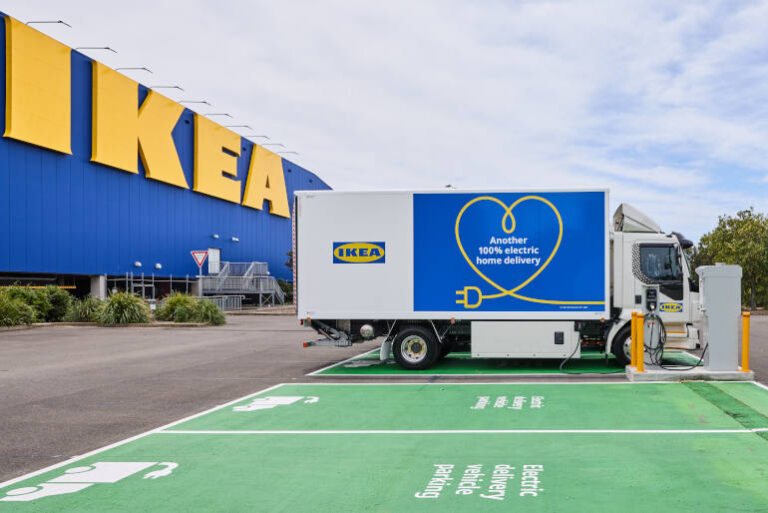
IKEA Australia has accelerated its journey toward 100% zero-emission home deliveries by investing in four long-range Volvo FL electric trucks and partnering with CarBon Leasing to launch an innovative leasing model designed to make electric vehicles more accessible to small delivery businesses.
The initiative allows IKEA to extend its zero-emission delivery footprint beyond metropolitan areas and into regional postcodes—helping the retailer reach more Australians sustainably. Since 2019, IKEA has worked with partners ANC Delivers, All Purpose Transport, and Kings Transport to deploy electric vehicles in its home delivery fleet, a move that has already resulted in nearly all metro-area truck deliveries being completed with zero-emission vehicles.
Removing financial barriers for small operators
According to Alexandra Kelly, Zero Emissions Project Leader, IKEA Australia & New Zealand, the biggest barrier to fleet electrification is financial accessibility for small contractors.
“It’s not well known that most (98%) of delivery vehicles are owned by small businesses or subcontractors, not delivery companies or retailers,” Ms Kelly said. “Electric vans and trucks remain significantly more expensive than diesel alternatives, which is a major challenge for drivers who operate with low margins.”
Under the new model, IKEA owns the electric trucks, which are then leased to ANC Delivers contractors through CarBon Leasing. This approach eliminates the need for drivers to fund the vehicles upfront and offers lease costs comparable to diesel trucks—making EVs a viable option for small businesses.
“By offering a leasing package as an attractive alternative to diesel trucks, drivers can access electric vehicles without financial risk,” Ms Kelly added. “With this new business model, we aim to prove that zero emission delivery is achievable today for retailers, with electric vehicles that can go the diesel distance.”
Partnering for scalable sustainability
Scott Gillespie, Managing Director of CarBon Leasing, said the partnership with IKEA demonstrates what’s possible when global ambition meets local execution.
“Our model removes the upfront cost barrier and supports drivers with everything from vehicle sourcing to charging and CO₂ reporting,” Mr Gillespie said. “Making zero-emissions delivery financially viable for small operators isn’t just good for business—it’s essential for Australia’s transition to cleaner transport.”
The partnership reflects a shift toward collaborative solutions between major retailers, logistics partners, and technology providers. IKEA’s $4.5 million national charging infrastructure investment complements this model, addressing one of the key hurdles to scaling electric delivery fleets: reliable access to charging.
Volvo’s long-range electric trucks take the lead
The newly introduced Volvo FL Gen 3 electric trucks will play a central role in extending IKEA’s zero-emissions delivery network into regional routes. The trucks are designed for longer distances, offering a range of up to 450 kilometres and a payload capacity of 5,500 kg.
Martin Merrick, President and CEO of Volvo Group Australia, highlighted the progress of electric mobility in the heavy transport sector:
“It’s been fantastic to see the evolution of electromobility here in Australia. Since the first electric FL arrived on our shores in 2020, this truck has only gotten better,” he said. “Our Australian electric truck fleet has now clocked up well over 1 million kilometres, proving that electric is indeed a reality for transport operators looking to reduce emissions and noise in urban areas.”
A growing zero-emission fleet footprint
IKEA’s progress underscores how far the company has come in just three years. In 2022, only 5% of truck orders were completed using zero-emission vehicles. As of October 2025, that figure has surged to 84%—nearly all home deliveries in metro areas.
Ms Kelly said the company’s next challenge is expanding this success beyond city boundaries:
“This partnership with Volvo and CarBon is a bold step toward our goal of 100% zero emissions deliveries. With collaboration and innovation, sustainable delivery is not just a future vision—it’s happening now. However, to truly scale zero-emissions delivery into outer metro and regional areas, we must overcome one of the biggest remaining barriers: charging infrastructure.”
“Addressing this challenge will require coordinated investment and action from government, industry, and the broader transport ecosystem.”
For fleet operators
For Fleet Managers, IKEA’s new model represents a real-world example of how shared ownership and innovative leasing can bridge the cost gap in fleet electrification. By combining OEM technology, retail logistics, and financial innovation, the IKEA–Volvo–CarBon partnership sets a practical precedent for how Australian fleets—large and small—can remove barriers to achieving zero-emission transport.