


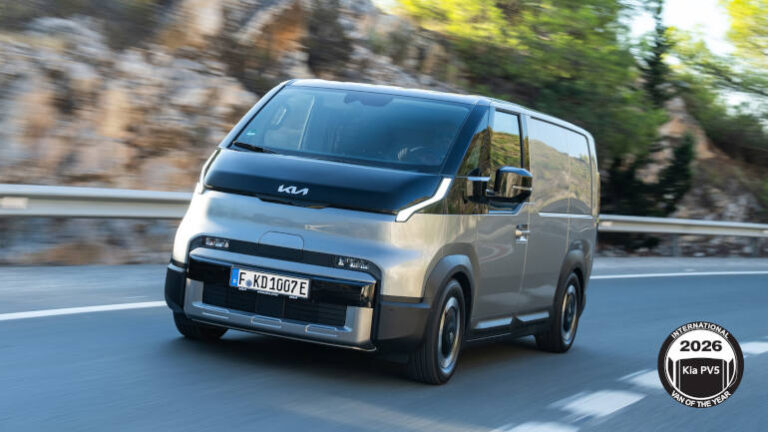
Kia has claimed one of the biggest prizes in the global commercial vehicle sector, with the all-electric PV5 officially crowned the 2026 International Van of the Year (IVOTY). For Fleet Managers, Sustainability Managers and Finance Managers evaluating the next wave of low- and zero-emission vans, this award signals that Kia’s entry into the light commercial vehicle segment is more than just another EV — it’s a serious fleet solution.
Unanimously chosen by a jury of 26 leading commercial vehicle journalists, the PV5 becomes Asia’s first electric vanand the first Korean model to secure the award in IVOTY’s 34-year history. It’s also the debut model in Kia’s Platform Beyond Vehicle (PBV) strategy — an important signal that electric commercial vehicles are accelerating rapidly in capability, flexibility and global recognition.
A Strong Vote of Confidence for Electric Vans
IVOTY judges evaluate entries on real-world productivity, innovation, safety, operational efficiency and environmental impact — all areas where EVs must prove their worth to fleet buyers.
IVOTY Chairman Jarlath Sweeney praised the PV5’s combination of practicality and electric performance, saying it “sets a new benchmark for innovation, efficiency, and all-round capability in the light commercial vehicle segment”, adding that the van “redefines what businesses can expect from a modern van.”
For Australian fleets preparing for NVES targets, tightening emissions reporting, and rising interest in zero-emission logistics, this type of international endorsement helps de-risk future procurement decisions.
Designed for Business, Informed by Operators
Kia President & CEO Ho Sung Song emphasised that the PV5 was built with direct input from commercial operators, with a focus on practicality and digital capability.
This aligns strongly with what local fleet teams want: practical EVs that slot easily into established roles without expensive redesigns of fleet operations.
The PV5’s Flexible Body System allows multiple upper-body modules — from cargo and passenger transport to conversion-ready shells. For fleets juggling diverse operational profiles, this type of modularity reduces complexity and speeds up deployment.
Real-World Range and Payload Usability
The PV5 is built on Kia’s dedicated E-GMP.S platform and offers:
- Up to 416 km WLTP range (Cargo Long)
- 10–80% DC fast charging in around 30 minutes
- Payload up to 790 kg
- Three battery options: 43.3 kWh, 51.5 kWh and 71.2 kWh
Importantly for fleet validation, the PV5 Cargo Long holds a GUINNESS WORLD RECORDS™ title for the longest distance travelled by a fully loaded electric van on a single charge: 693.38 km.
This matters. Many fleet teams are still testing EV range under real payload conditions, particularly in regional areas or multi-stop delivery routes. Demonstrated long-range performance with maximum load is a compelling data point.
Built for Fleets: Safety, Serviceability and Digital Capability
From the platform up, the PV5 incorporates:
- A reinforced multi-load-path body
- Expanded high-strength steel use
- EV-specific battery protection
- ADAS including Surround View Monitoring and Lane Keeping Assist
It also includes a built-in AI assistant, integrated fleet-management tools and an app marketplace. For organisations moving toward connected fleet ecosystems, this boosts uptime and reduces administrative burden.
Modular exterior components also reduce repair time and cost — essential for Finance Managers modelling whole-of-life costs (WOLC) and downtime risk.
Europe First, More Variants Coming in 2026
The PV5 is launching initially in Europe in:
- Cargo Long
- Passenger 5-seater
More variants will follow from 2026:
- Chassis Cab
- Cargo Standard (L1H1)
- High Roof (L2H2)
Additional PBV models, including the larger PV7 and PV9, will further expand the family.
For fleet decision-makers, this signals Kia’s long-term commitment to commercial EVs — not just a one-off van, but an entire electric workhorse ecosystem.
Why This Matters for Australian Fleets
While Australian release timing has not yet been confirmed, Kia’s IVOTY win is likely to attract strong interest from:
- Fleet Managers seeking operationally capable EV vans to meet internal sustainability and NVES requirements.
- Sustainability Managers looking for demonstrable emissions reductions without compromising service levels.
- Finance Managers modelling EV TCO improvements through lower running and service costs, modular repairs, and connected-fleet uptime gains.
The global recognition places Kia firmly alongside Europe’s established commercial van players — but with a fresh, EV-first architecture.