


Electric trucks are often discussed through the lens of large fleets, government trials and major corporate decarbonisation programs. But according to Fleet Plant Hire and Vertu Group, the next phase of uptake in the construction sector could come from a very different part of the market: small and medium operators.
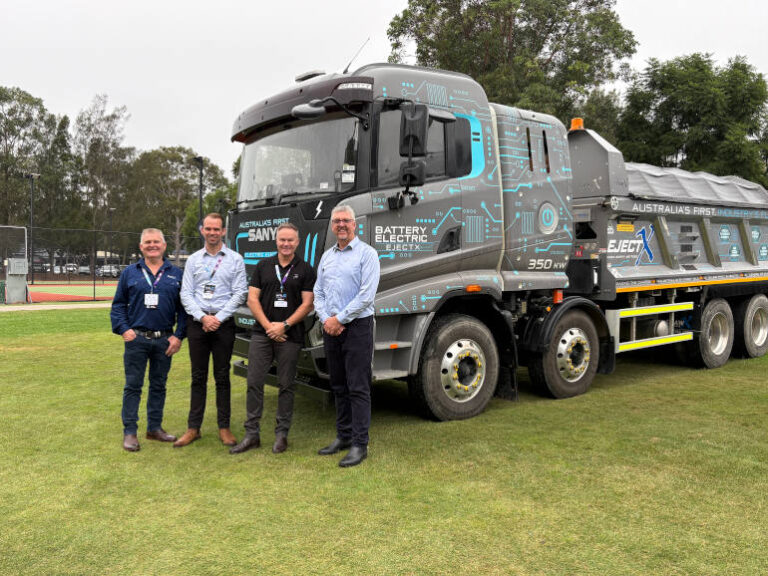
Speaking at TruckShowX 2026 in the Hunter Valley, Chris West, Managing Director at Fleet Plant Hire, said the company had already sold eight Sany electric trucks and was preparing to bring in around 150 next-generation vehicles.
The significance is not only the number of trucks, but the type of customers showing interest. Rather than relying on a single large fleet deal, West said early demand was coming from smaller businesses and individual operators who are looking closely at operating costs, driver comfort and the commercial practicality of electric trucks.
“Individual operators, so small to medium operators,” West said. “It’s the best way to make inroads into the market in the heavy vehicles, rather than say a one-off fleet purchase of 30, 40, 50.”
For the construction sector, where many trucks are owned and operated by subcontractors, that distinction matters. A large fleet order can make headlines, but wider market adoption depends on whether electric trucks can work for operators who make purchasing decisions one vehicle at a time.
West said the appeal was not simply environmental. While zero-emission operation is part of the story, the stronger argument for many operators is the potential to reduce exposure to diesel costs while improving the driver experience.
“We’re finding more so that they are better for driver fatigue,” West said. “Obviously, your running costs after a period of time are much cheaper, and most drivers are looking at it as being an alternative to what has been around.”
He said diesel remains a major operating cost in the applications Fleet Plant Hire works in, making electric trucks increasingly attractive as the economics improve.
“It’s not just the fact that it’s new energy and that it’s green,” West said. “The main driver has been they’re a better outcome for the driver themselves.”
Jonathon Griffiths, Managing Director at Vertu Group, said the project was important because it was taking electrification into one of the harder sectors to shift.
“I think one of the great things as well about this project is we’re sort of revolutionising one of the most traditional industries being construction,” Griffiths said. “Construction is sort of the last mile when it comes to actually transitioning.”
For Griffiths, the value of the model being developed by Fleet Plant Hire is that it pushes the technology beyond boardroom-level fleet decisions and into the hands of working operators.
“What Fleet’s doing in particular is revolutionising that industry, but also flowing it down to individual drivers,” Griffiths said. “It’s not just one particular fleet buy.”
The business case has changed significantly in recent years. West said that when he first assessed electric heavy vehicles, the numbers were difficult to justify, even with funding support available.
“Two, three years ago, when I started this journey checking against the European vehicles, it just didn’t stack up financially,” West said. “It wasn’t there, regardless of the funding that was available through ARENA.”
He said the arrival of new electric truck models from China and other markets had changed the equation for operators.
“Now a couple of years on, the new models coming in, and some of the other OEMs coming in from China and from other countries, it more than stacks up,” West said.
West acknowledged that some European trucks may offer higher levels of finish and refinement. But for many construction operators, the key measure is whether the truck can reliably complete the work and remain on the road.
“The European models are probably a little bit better finished off, and their technology, or their refinement, is definitely better,” West said. “But for what we do in our application, they get paid the same, whether they are running a $50,000 10-year-old truck or a $450,000 brand new vehicle.”
That puts the focus on whole-of-life value rather than badge prestige. In construction, where trucks are revenue-generating tools, purchase price is only one part of the decision. Uptime, servicing, parts supply and aftersales support are just as important.
“For them, value for money comes out of the reliability, which comes back to the servicing and the after-sale support, and the ability to keep the truck on the road,” West said. “If you can do that, it doesn’t matter what brand you’re driving, you’re in the best position possible to make money.”
West said Sany’s scale and support, combined with Vertu’s local role, had been critical in building confidence around the product.
“You also need that proven service availability or aftermarket part,” West said. “Sany will through Vertu, and then Sany, obviously they’re a massive overseas business, their support has been critical in actually facilitating what we hope to be the largest deployment.”
The truck on display at TruckShowX was a Gen One 8×4 model with a 350kW battery. West said Fleet Plant Hire had been using the vehicle since January on normal construction sites, without asking customers to restrict its duties.
“We have used that truck since basically January on normal construction sites,” West said. “We don’t ask the client who’s using it to put it on particular parts of a job, so it doesn’t sit on site all day.”
According to West, the truck has generally been completing around 250 to 300 kilometres per day and charging back overnight. That aligns with the operating profile of many tippers, which are not usually high-kilometre linehaul vehicles.
Griffiths said that real-world proof point had been central to the project.
“Our whole mandate from Fleet, or the whole mandate working together, has been making sure these things work in the real world,” Griffiths said.
For small and medium operators, that may be the key. Electric trucks will only move beyond trials when the commercial model is practical, the vehicle can do the job, and the support network gives operators confidence to make the switch.
The emergence of lower-cost Chinese electric trucks does not remove every barrier to adoption. Charging, payload, resale values, parts availability and finance will still need to be assessed carefully. But for construction operators watching diesel costs and looking for ways to improve driver retention and reduce operating risk, the Sany program points to a different path into electrification — one led not by large fleet mandates, but by operators who can see a business case vehicle by vehicle.