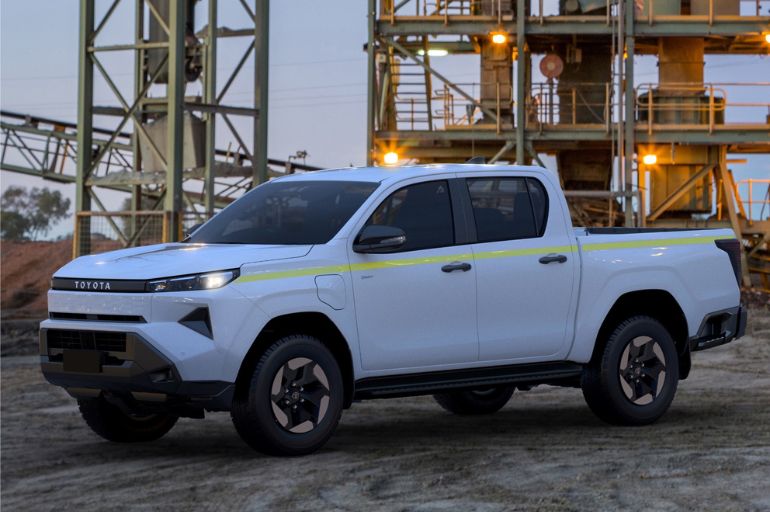


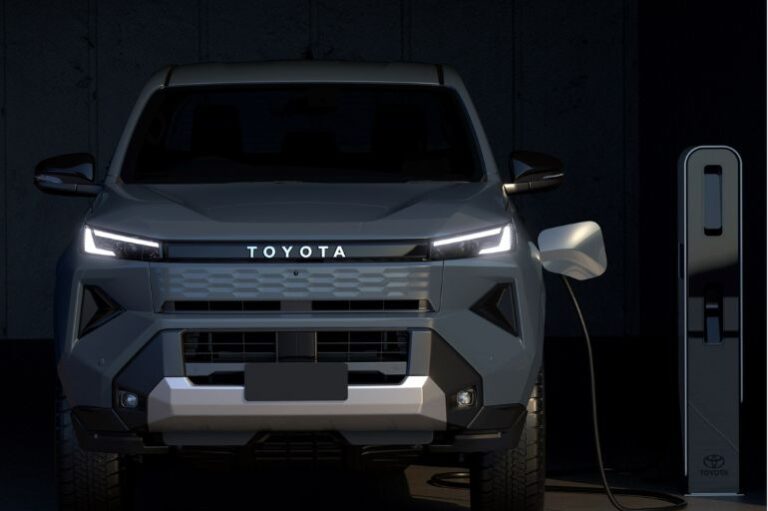
After years of cautious observation from the sidelines, Toyota has finally confirmed it will launch a battery-electric HiLux in 2026 — a decision that marks a significant shift for Australia’s top-selling vehicle and for the brand long accused of being “anti-EV.”
Speaking at Toyota’s exclusive media preview in Melbourne, Sean Hanley, Toyota Australia Vice President of Sales, Marketing and Franchise Operations, said the BEV HiLux will initially target fleets and urban trade operators — customers who can take full advantage of predictable routes, controlled charging environments, and low daily kilometres.
“We will be launching a fully electric HiLux in 2026,” Mr Hanley announced. “Our multi-pathway approach has always been about providing vehicles with the right powertrain for the application or customer use. We’ve seen a growing demand for BEVs in the ute space, particularly among fleet buyers.”
That admission marks a major philosophical milestone for Toyota. For years, the company’s executives have defended a diversified “multi-pathway” strategy — hybrids, plug-in hybrids, hydrogen fuel-cell and biofuels — arguing that battery-electric vehicles aren’t the only answer to decarbonisation. Yet this move shows that even the world’s biggest carmaker can read the direction of travel: EVs are becoming normal.
Hanley said the decision was driven by clear signs that Australian business customers — especially those in mining, government and corporate fleets — are starting to demand electric options.
“These are vehicles that will be used largely in short-distance operations that need the payload and passenger capacity and are able to be recharged easily and economically,” he said. “The new double-cab 4×4 HiLux BEV will be available for anyone who wishes to purchase one, but we are primarily targeting fleets and urban trade users that will benefit most from the advantages a BEV offers.”
It’s a bold step for a company that has spent much of the last decade refining hybrid technology while others — from startups to aftermarket engineers — tried to build their own electric HiLux conversions. Several of those attempts have struggled to gain commercial traction, largely because of battery packaging constraints, high costs, and uncertain support networks. Toyota’s factory-developed solution, backed by its dealer footprint and parts supply, changes that equation overnight.
Still, Hanley was careful not to over-promise.
“We know this is not going to be our biggest seller,” he said. “But it’s got to be competitive and affordable for those that want it. There’s a niche market where we can put this car, and in mining it will be massive.”
He added that the BEV HiLux represents the next step in Toyota’s long game of decarbonisation, alongside low-carbon fuels and hydrogen technologies.
“The HiLux BEV is an integral part of our multi-pathway approach to decarbonisation,” Mr Hanley explained. “If our customers still demand diesel vehicles, we’ll continue to meet that need, but we’ll work with government, suppliers and other partners to find solutions such as hydrogen and biofuels that can also address the climate challenge.”
Beyond its immediate commercial intent, the announcement carries symbolic weight. For many, the HiLux is Australia’s automotive benchmark — the vehicle that defines the ute segment and dominates both fleet and retail sales. A battery-electric HiLux, even in modest numbers, signals that the EV transition has reached the heart of Australia’s light-commercial market.
Toyota hasn’t disclosed details of the battery size, range, or electric motor configuration, saying only that further information will be revealed closer to launch in the first half of 2026.
But the intent is clear: to give corporate and industrial buyers confidence that a fully electric HiLux — supported by Toyota’s quality, durability and reliability — can fit into their sustainability strategies without sacrificing capability.
In a country where utes are as common as coffee runs, Toyota’s move isn’t just another model launch; it’s a cultural pivot. The world’s most trusted ute is finally plugging in. And if even the HiLux is going electric, perhaps Australia’s EV future is a lot closer than we think.