


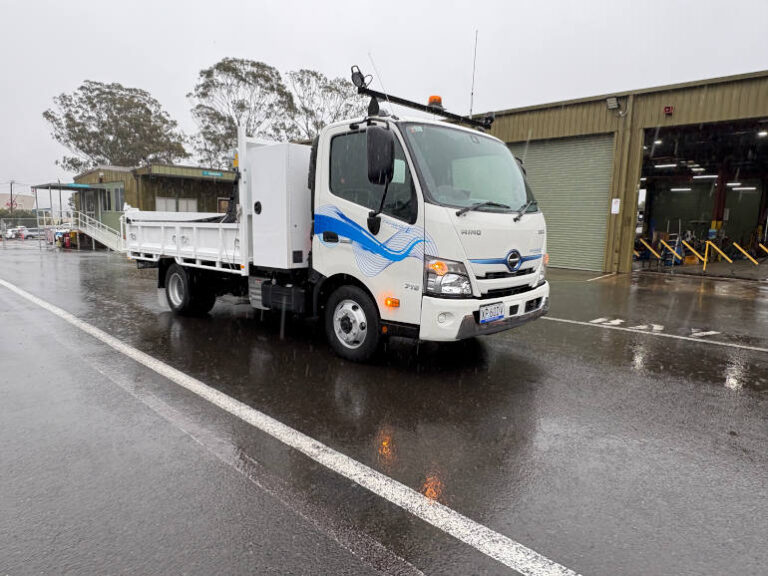
Hybrid trucks are not a one-size-fits-all solution, but for the right customer and the right application, they can deliver significant savings and emissions reductions. That’s the message Hino is driving home as it retrains its dealer network on how to position the 300 Series Hybrid with potential buyers.
Targeting business-focused operators
According to Daniel Petrovski, Manager of Product Strategy at Hino Australia, the hybrid is best suited to operators who take a business-first approach.
“It’s about picking those customers who are there to make money, rather than the guys who are more impressed with horsepower,” Petrovski explained.
In practice, this means businesses that monitor fuel use closely and are focused on operational efficiency. “You ask a transport operator how much fuel they use, and they’ll tell you 16 litres per 100 kilometres. They’ll know every truck and every driver. Those are the customers to talk to about hybrid fuel savings of 20%,” Petrovski said.
Applications that maximise savings
The Hino Hybrid shines in applications where trucks are working hard in stop-start urban or regional routes. Regenerative braking helps recharge the battery, while carrying a load improves efficiency.
“Our trucks aren’t driving around empty – if they are, they’re losing money. With 80% of operations running loaded, that’s when the hybrid performs at its best. The gear shifts are smoother, fuel use is lower, and the emissions savings are greater,” Petrovski noted.
Council fleets, last-mile delivery operators, and rental companies are examples of customers already trialling hybrid tippers, tray bodies, and other applications.
Not for every customer
Petrovski is quick to point out that hybrids won’t suit every fleet:
“Every vehicle is not suitable for every customer. Otherwise, you’d just have one ultimate vehicle. Trucks are used in different ways, and customers have different needs. The hybrid is a perfect fit for customers who want lower running costs and emissions, but it won’t be right for everyone,” he said.
Immediate savings
For the right operator, the financial case is strong. Petrovski said that when you look at monthly outgoings, hybrids can save money from day one:
“From month one, when you do a return-on-investment calculation, the hybrid comes out around $100 a month less outlay compared to a diesel. It’s not just about a payback in two or five years – it’s immediately beneficial,” he explained.
A stepping stone technology
With more than 1,200 units sold in Australia, Hino is confident hybrids will continue to grow as fleets look for a balance between sustainability and practicality. For operators focused on lowering operating costs and reducing their carbon footprint, hybrid electric trucks provide a proven solution that works within existing business models.