

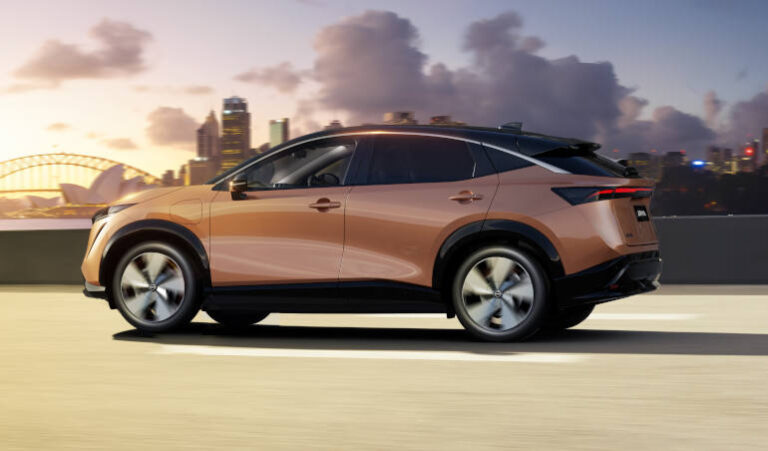
When Nissan unveiled the Ariya in Australia, it wasn’t just launching another electric SUV — it was introducing a bold new chapter in the brand’s design and engineering philosophy. As Ben Warren, Senior Product Marketing Manager – Electric Vehicles and Small SUV at Nissan Australia, explained, the Ariya represents “the next wave of product” for the brand and a major leap forward from the pioneering Leaf.
“It’s truly a step up in terms of design language and presentation,” said Warren. “Our designers call it timeless Japanese futurism. The whole thing is really a representation of Japanese hospitality.”
That ethos is woven throughout the Ariya’s cabin and exterior. From the traditional kumiko patterning inspired by Japanese woodwork to the andon lighting in the footwells and doors—modelled on paper lanterns that historically welcomed guests—the Ariya aims to make drivers feel both calm and connected. “Back in the day, lanterns out the front of places meant ‘we’re open, you’re welcome.’ That theme comes through everywhere in the car,” Warren explained.
A Modern Expression of Heritage
The Ariya’s proportions are defined by short overhangs and a long wheelbase, maximising cabin space. The front end may lack a traditional frunk, but that’s by design. “To accommodate a frunk, you have to have a bigger bonnet, which means less cabin space,” said Warren. “We condensed everything vertically — even the HVAC system sits on the other side of the firewall — to make the interior more open and airy.”
That decision delivers a distinctive cabin experience: a flat floor, expansive footwells, and an elegant dashboard that blends form and function. “We wanted to preserve the beauty of the concept while keeping the high-traffic buttons people need,” Warren said. “The haptic touch controls are integrated into the wood grain finish — it’s art versus science.”
Next-Generation EV Technology
Underneath the sculpted bodywork, the Ariya introduces Nissan’s latest electric drivetrain technology. “It’s our next-generation e-motor,” Warren said. “We’ve learned a lot from the Leaf in how to package everything more efficiently.”
For the dual-motor e-4ORCE variants, engineers positioned the rear motor at a 30-degree angle to maximise boot space. “It’s a different packaging approach that’s really clever,” he added.
Battery management has also taken a leap forward. “One of the key issues on the Leaf was that it was passively cooled — it had no active thermal management,” said Warren. “The Ariya has a very advanced liquid-cooled system with battery heating for optimal charging performance.”
While the peak DC charging rate of 130kW may not sound headline-grabbing, Warren said the secret lies in the charge curve. “It stays near that peak for much longer. The time you spend at the charger — around 35 minutes — is what really matters. We learned that it’s not about peak power; it’s about consistency and customer time.”
Fit for Purpose: Fleet and Everyday Use
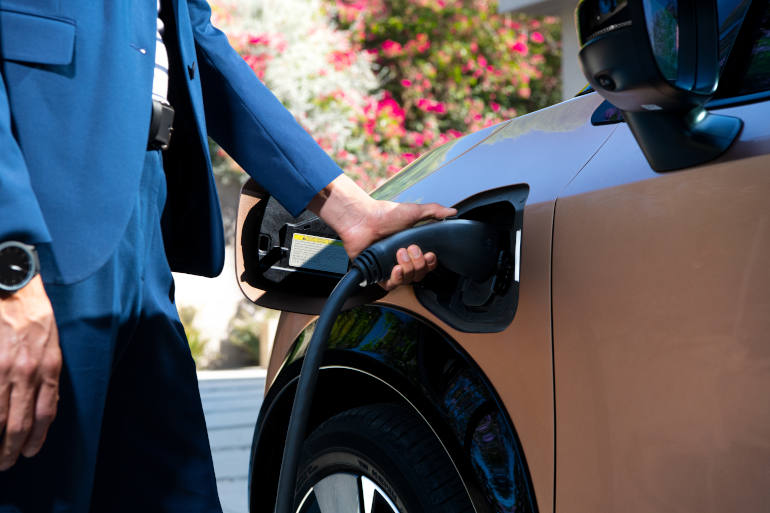
Charging time, Warren said, depends on use case. “For fleet customers, fast charging is more important than for everyday consumers. Most private owners will charge at home or work — it’s 10 seconds to plug in and 10 seconds to unplug. But for drivers out on the road, managing charging times and curves is critical.”
Nissan’s approach with the Ariya was to design around real-world conditions. “It’s about where you locate charging infrastructure — places where drivers naturally stop for 10 or 20 minutes,” Warren said. “In that time, you can add a huge amount of range.”
The Ariya’s launch range also includes a complimentary upgrade to a 22kW three-phase onboard charger on selected grades, tripling AC charging speed. “If you’ve got three-phase power at home or work, you can charge three times faster,” Warren said.
Attention to Detail Inside
Inside, the Ariya merges traditional craftsmanship with modern technology. The heated and cooled seats and steering wheel are linked to the climate control system, automatically adjusting with temperature changes. “We’ve paired them so you’re not fiddling with more buttons,” Warren explained.
While some practicality trade-offs were made—limited centre console storage, for instance—the design intent was deliberate. “The designers absolutely fell in love with the aesthetic. It’s gorgeous,” said Warren with a laugh. “Art versus science — they probably won that one.”
Built for Peace of Mind
From an ownership perspective, the Ariya benefits from Nissan’s Nissan Intelligent Mobility platform and the Nissan Warranty Advantage, offering up to 10 years of coverage and capped-price servicing.
Warren said those long-term assurances are part of what gives Nissan products enduring appeal among Australian fleet buyers. “We are who we are — stable pricing, national dealer network, long-term reliability. None of it’s sexy when you’re reviewing a car, but it’s critically important in the ownership cycle.”
Looking Ahead
With the Leaf now phased out and new models like the Qashqai e-POWER on the way, the Ariya marks the start of Nissan’s next era in electrification. “Over the next couple of years, we’ll see more e-POWER derivatives,” Warren confirmed. “A new-generation e-POWER powertrain launches in Europe soon, and we’ll pick that up in the Qashqai. It’s our bridging technology to full electrification.”
As for what comes next? “The market’s ready now,” Warren said. “We probably could have brought the Ariya earlier, but timing matters. It’s a ripping product, the right car at the right time.”
- Kia targets government, utilities and delivery fleets with PV5
 The Kia PV5 is finding traction beyond small businesses and tradies, with Kia targeting government, utilities, larger corporates and last-mile delivery operators as key customers for its first dedicated electric commercial vehicle. Since its Australian launch earlier this year, the PV5 has been well received, with sales exceeding Kia’s initial expectations and strong demand across
 - BYD and Amber Expand V2G PartnershipAmber Electric and BYD Australia have expanded their vehicle-to-grid partnership to include the BYD Sealion 7, giving more Australian EV owners access to technology that can turn a parked vehicle into a household energy asset. The Sealion 7 joins the Atto 3 in Amber’s vehicle-to-grid (V2G) program, which is being scaled to 1,000 Australian households
- How Much EV Range Does a Fleet Really Need?Ford is making the case that electric commercial vehicles should be sized around the work they actually do, rather than chasing the biggest possible battery and the longest headline range. That thinking sits behind the new Ford Transit City, which uses a 56kWh battery and offers a quoted 254km WLTP combined driving range. While that
- Electric trucks are coming, but Hino sees 2029–2030 as the turning pointThe transition to electric trucks in Australia is likely to take longer than some fleets originally expected, with Hino Australia President and CEO Richard Emery suggesting 2029–2030 remains a realistic timeframe for a broader shift in customer demand. Speaking while driving a Hino 700 Series at a recent customer event, Emery said fleet interest in
- Are your repair networks ready for an electrifying fleet?As more electric vehicles enter Australian fleets, the conversation about electrification is moving beyond vehicle selection, charging and energy costs. Fleet managers also need to consider what happens when those vehicles are damaged. That raises a broader question: is the existing repair network still fit for the fleet you are building? For DingGo Co-Founder and