


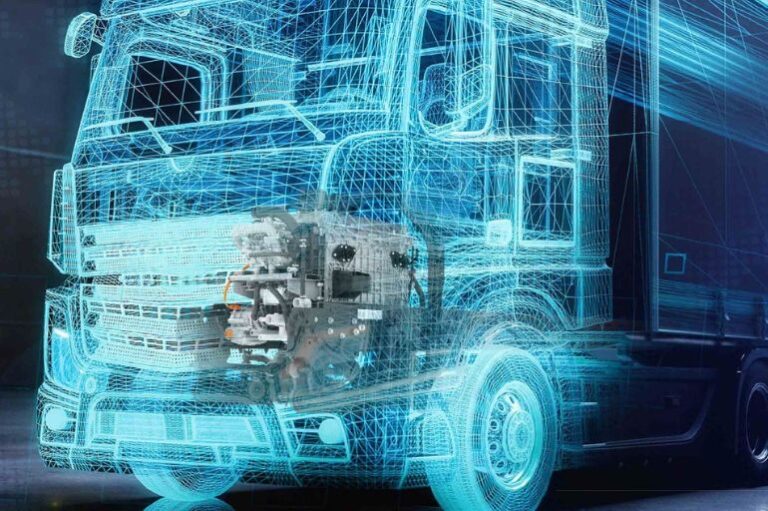
At the Australian Trucking Association’s (ATA) Technology and Maintenance Conference (TMC) 2025, hydrogen took centre stage as experts explored its potential to transform Australia’s heavy transport sector.
Nathan Pearce-Boltec, Technical Solutions Engineer at BOC South Pacific, told delegates that hydrogen is emerging as a key low-emission fuel for hard-to-abate sectors such as long-haul road freight, mining and high-productivity vehicles.
“Hydrogen is obviously zero-emission — you can combust it safely in a conventional engine or use it in fuel cells,” Pearce-Boltec explained. “It’s also abundant and can be produced from water or wastewater streams using renewable power. For applications where battery-electric isn’t practical, hydrogen can provide the range and refuelling speed operators need.”
Hydrogen’s role in decarbonising heavy transport
Pearce-Boltec said hydrogen offers the energy density and rapid refuelling that make it well-suited to long-distance and high-utilisation transport. “For back-to-base fleets or long-haul corridors, hydrogen enables 1000-kilometre range and 10-minute refuelling times — that’s the kind of performance operators are used to,” he said.
By comparison, battery-electric trucks require much larger charging infrastructure and longer downtime between shifts. “It’s not a case of hydrogen versus electric,” he added. “We see hydrogen complementing battery-electric in the broader decarbonisation strategy — particularly where weight, range and charging constraints limit electric options.”
Support from all levels of government
Pearce-Boltec acknowledged that government support is accelerating Australia’s hydrogen ambitions. “We’re seeing significant investment from federal, state and local governments to get hydrogen projects up and running,” he said.
New facilities in Kwinana (WA) and Port Kembla (NSW) will provide refuelling capacity for buses and industrial vehicles, while long-standing hydrogen producers in Queensland and Tasmania are expanding to supply emerging mobility projects. “These are early steps, but they’re building the foundation for a national hydrogen network,” he said.
At the national level, the Transport and Infrastructure Net Zero Roadmap recognises hydrogen as essential to achieving emission reduction targets for heavy vehicles. State governments, meanwhile, are funding pilot projects and fleet trials across public transport, waste collection and logistics. “That coordinated support is what will make the difference,” Pearce-Boltec said.
“It’s encouraging to see governments getting serious about this opportunity,” he told the audience. “Hydrogen production creates regional jobs, builds new manufacturing capability and supports decarbonisation right across the supply chain.”
Infrastructure and technology coming together
BOC, part of global industrial gas company Linde, is at the forefront of hydrogen infrastructure in Australia, developing the country’s first public refuelling stations and working with OEMs and fleet operators to deliver fuel solutions.
In Europe, BOC’s parent company operates high-capacity hydrogen refuelling networks that support buses, trucks and municipal vehicles. Pearce-Boltec said that experience is now being applied locally. “Our ionic liquid hydrogen compressor — developed at our Centre of Excellence in Austria — is the most efficient compressor in the world, and it’s already being used in refuelling stations, including Toyota’s site in Melbourne,” he said.
He described how hydrogen refuelling sites can operate efficiently with existing grid connections. “A hydrogen station refuelling 30 trucks a day draws less than 250 kilowatts,” he said. “By comparison, a single high-capacity EV charger can exceed one megawatt. That’s a massive difference in infrastructure load and cost.”
Unlocking regional opportunity
Pearce-Boltec highlighted the potential for regional hydrogen hubs to power local industry and transport. “In regional and remote areas, you’ve got abundant renewable energy and access to water. You can produce hydrogen locally and use it to power trucks, mining equipment or even export it as a clean energy source,” he said.
Hydrogen can also be distributed much like today’s fuels. “Liquid hydrogen can be transported and stored using existing logistics frameworks,” he explained. “Once we have large-scale production and distribution, we’ll be able to deliver hydrogen to operators just like diesel.”
Building confidence in a new fuel
While the technology is proven, Pearce-Boltec said education and community engagement will be critical to hydrogen’s rollout.
“We’re not doing a good enough job explaining hydrogen to the public,” he admitted. “If you asked people whether they’d be comfortable with a hydrogen refuelling station near their children’s school, most would probably say no — and that’s because they don’t understand how we manage the risks. Hydrogen can be handled as safely as diesel or LPG, but we need to earn that trust.”
He said this education must go hand-in-hand with the development of industry standards and training for technicians, engineers and first responders. “Right now, we’re still seeing confusion about who’s qualified to sign off on hydrogen systems,” he said. “That’s something we need to address quickly as more vehicles and facilities come online.”
A new era for transport
Pearce-Boltec sees hydrogen’s emergence as part of a wider shift toward cleaner, smarter transport solutions. “Every major economy is investing in hydrogen because it links renewable energy to the hardest-to-decarbonise sectors,” he said. “Australia has all the ingredients — solar, wind, water, technical expertise, and government support — to build a globally competitive hydrogen industry.”
For road transport, the opportunities are tangible. “Hydrogen is not just an alternative fuel; it’s a pathway to keep our heavy transport sector productive while meeting our emissions targets,” he concluded. “With the right policies and continued investment, we can make hydrogen a real part of Australia’s transport future.”
- Geely Adds AWD Muscle to Starray EM-i
 Geely Auto Australia is expanding its Starray EM-i plug-in hybrid SUV range with a new all-wheel-drive variant, giving fleet buyers another option where electric driving needs to be combined with longer-distance capability and more challenging road conditions. The Starray EM-i Inspire AWD will arrive in Australian dealerships from mid-September 2026, joining the existing Complete and
 - Polestar 4 SUV Adds a More Practical OptionPolestar has expanded its Australian electric vehicle line-up with the launch of the Polestar 4 SUV, adding greater cargo capacity and utility to the existing Polestar 4 platform. The new SUV retains the electric performance focus of the Polestar 4 coupé but introduces a redesigned rear body, more luggage capacity, roof rails and additional rear-seat
- Chery Expands Again with iCAUR V25Australia’s increasingly crowded electric vehicle market will welcome another brand in 2027, with Chery Group confirming iCAUR will make its local debut led by the distinctive V25 SUV. iCAUR has announced plans to officially enter Australia in early 2027, positioning itself as a lifestyle-focused new energy vehicle brand combining electric performance, technology and a deliberately
- BYD Enters People-Mover Market With M9BYD is expanding its Australian new energy vehicle line-up with the M9, a premium people mover that combines seven- or eight-seat practicality with significant electric-only driving capability. Confirmed for Australian showrooms in the fourth quarter of 2026, the M9 will be BYD’s first entry into the local people-mover segment and will be offered exclusively with
- JAC Gives Hunter PHEV an Aussie TuneJAC Motors has put Australian engineering at the centre of the launch of its new Hunter PHEV, confirming that every production vehicle sold locally will receive the complete suspension and vehicle dynamics tune developed during an extensive Australian testing program. The company says it has invested several million dollars beyond its standard product development costs