Electric utes were expected to lead the local government EV transition. Instead, a striking trend emerged at the inaugural Fleet EV Expo for Local Government: small electric trucks are accelerating ahead while electric utes lag 18–24 months behind. That reality shaped one of the most honest and practical discussions of the day, as fleet managers, OEMs and procurement specialists unpacked why this shift is happening—and what it means for operational planning.
A Market Moving in an Unexpected Direction
Setting the scene, John Ravlic, Principal Consultant at Ravim RBC, opened the session with a surprising insight.
“We just didn’t envisage that we would have more suppliers of small electric trucks than we did of electric utilities. We were expecting a whole bunch of electric utilities to be announced… But what we discovered is that today we’ve got four or five suppliers of electric small trucks.”
The transition is not unfolding the way councils expected. Rather than waiting for EV utes that are still one to two years from market readiness, manufacturers have delivered viable small electric trucks now, and councils are responding.
Small Trucks Fit the Duty Cycle Better Than Expected
For many councils, the barrier has never been philosophical—it’s operational. Romesh Rodrigo, Head of Regulatory Affairs and Emerging Mobility Sales at Daimler Truck Australia Pacific, argued that councils should rethink old assumptions about what roles a “ute” must fulfill.
Rodrigo pointed out that Daimler’s own electric light truck offering has unexpected advantages.
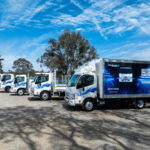
“That little eCanter out there is a car-licensed vehicle… about 400 millimetres shorter than a Toyota Hilux Workmate. It’s a true three-seater, it has a longer loading area, and the chassis height is at my hip. When you put it into context, it changes the equation.”
He added that many municipal tasks—branch pickups, parks work, waste runs, depot shuttle duties—sit comfortably within the vehicle’s range and capacity.
Rodrigo explained that councils must reframe electrification: it’s not a “like-for-like” replacement exercise.
“We’re not in a like-for-like transition at the moment. There’s a push from ESG requirements, and it takes lateral thinking to make sure we accomplish things the right way and avoid stranded assets.”
Driver Acceptance and Use-Case Reality Still Matter
On the ground, fleet teams are navigating the human factors that come with change. Chris Wood, Fleet Replacement Program Officer at Merri-bek City Council, laid out the practical challenge plainly.
“Asking a driver to ditch their dual-cab ute for a single-cab truck is not an attractive proposition, especially if they take it home at night.”
Yet even with those hurdles, Wood acknowledged that a significant portion of the ute fleet may not need to be utes anymore.
“There’s definitely a considerable portion of our ute fleet with very light trade application. But in operations like Brunswick, with very narrow streets, there’d be hesitation to move from a ute to a truck, even though technically they might be more fit-for-purpose.”
Councils are now asking whether vans or small trucks better meet long-held operational requirements, especially where cargo separation (chemicals, dead animals, waste) is needed.
Infrastructure Is Less of a Barrier Than Councils Assume
Several councils noted that lack of charging capacity was delaying their ability to trial or procure electric trucks. But Mike McCosker, National Key Accounts Manager at Foton Mobility, countered this perception directly.
“If your workshop has a 32-amp, three-phase power point—which most council workshops have—that’s all that’s required to get a Foton or a Fuso charged in a number of hours. There’s no extra infrastructure right now.”
He emphasised that infrastructure only becomes a capex issue when councils scale beyond a handful of EV trucks. Early adoption can be done with minimal upgrades.
McCosker also referenced the accelerating pace brought on by the 2035 emissions target.
“It’s put an accelerator on what was a slow-to-take-off market. Councils are doing their homework, and now that competitive product with backup, service, parts and warranty is here, it’s at a crescendo.”
Range Anxiety Is a Passenger-Car Problem—Not a Truck Problem
Rodrigo reminded councils that municipal operations rarely resemble private EV use cases.
Most council trucks:
- remain within tight municipal boundaries
- do predictable daily kilometres
- return to depot nightly
- can charge on AC if needed
His example: the eCanter’s 90 km real-world range.
“A lot of people say that’s not much. The battery capacity is less than many cars here—but you can carry one of those cars on the back of that truck. It’s about horses for courses.”
When fleet teams focus on actual duty cycle data, most small-truck applications fall well within EV capability.
Procurement Models Are Supporting the Shift
While OEMs innovate, procurement frameworks are evolving too. MAV Procurement Business Development Manager Steve Downs reinforced that councils have access to significant, existing buying power through aggregated contracts.
“Our national truck contract has delivered an average 20% discount. There’s no need for a 300-page tender for a $200,000 truck. Put your spec on VendorPanel, and it’s done.”
Downs also highlighted that the contract now includes EV options—and that the time saved can be redirected into the planning and infrastructure work councils need to complete.
Why Electric Trucks Are Overtaking Utes
From the combined perspectives of procurement, OEMs and fleet operators, the reasons are clear:
- Electric trucks are already available, while electric utes are still 18–24 months away
- Trucks better match fixed municipal duty cycles
- Charging can be handled with existing 3-phase outlets
- Trucks are exempt from driver-reservation issues tied to private-use benefits
- ESG, emissions targets and community expectations are accelerating adoption
- Procurement pathways for trucks are already mature
For councils trying to hit 2030–2035 climate targets, the path of least resistance—and highest operational fit—is currently small electric trucks, not utes.
The Takeaway for Councils
The panel delivered a consistent message – If councils wait for EV utes, they will lose valuable time. Small electric trucks are ready now—and in many cases, more fit-for-purpose than the utes they might replace.
As EV truck technology grows more capable and municipalities sharpen their operational analysis, 2026 may well become the year small electric trucks move from trials to mainstream procurement.
- Kia targets government, utilities and delivery fleets with PV5
 The Kia PV5 is finding traction beyond small businesses and tradies, with Kia targeting government, utilities, larger corporates and last-mile delivery operators as key customers for its first dedicated electric commercial vehicle. Since its Australian launch earlier this year, the PV5 has been well received, with sales exceeding Kia’s initial expectations and strong demand across
 - BYD and Amber Expand V2G PartnershipAmber Electric and BYD Australia have expanded their vehicle-to-grid partnership to include the BYD Sealion 7, giving more Australian EV owners access to technology that can turn a parked vehicle into a household energy asset. The Sealion 7 joins the Atto 3 in Amber’s vehicle-to-grid (V2G) program, which is being scaled to 1,000 Australian households
- How Much EV Range Does a Fleet Really Need?Ford is making the case that electric commercial vehicles should be sized around the work they actually do, rather than chasing the biggest possible battery and the longest headline range. That thinking sits behind the new Ford Transit City, which uses a 56kWh battery and offers a quoted 254km WLTP combined driving range. While that
- Electric trucks are coming, but Hino sees 2029–2030 as the turning pointThe transition to electric trucks in Australia is likely to take longer than some fleets originally expected, with Hino Australia President and CEO Richard Emery suggesting 2029–2030 remains a realistic timeframe for a broader shift in customer demand. Speaking while driving a Hino 700 Series at a recent customer event, Emery said fleet interest in
- Are your repair networks ready for an electrifying fleet?As more electric vehicles enter Australian fleets, the conversation about electrification is moving beyond vehicle selection, charging and energy costs. Fleet managers also need to consider what happens when those vehicles are damaged. That raises a broader question: is the existing repair network still fit for the fleet you are building? For DingGo Co-Founder and