
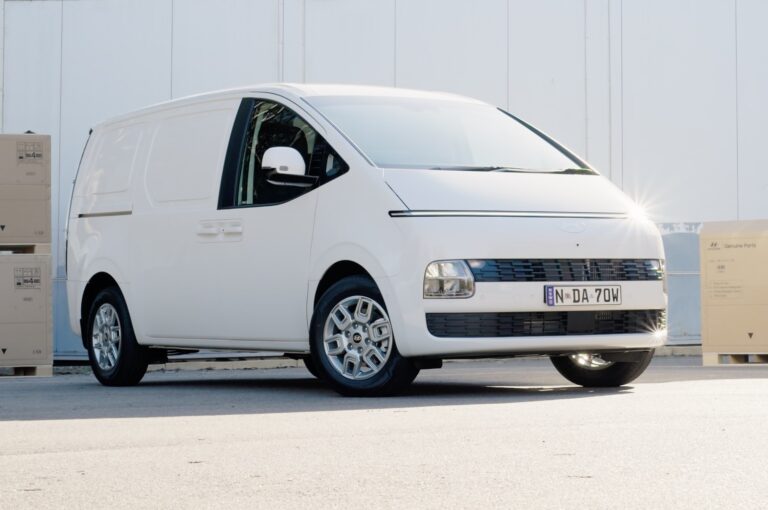
When Fleet Managers evaluate a new vehicle, the purchase price is only one part of the equation. Whole-of-life cost (WOLC) analysis considers acquisition, servicing, fuel, depreciation and operating costs over the vehicle’s life, providing a much better indication of overall value.
Fleet News Group’s WOLC assessment of the new Hyundai STARIA Load range highlights an interesting result. While the hybrid costs more to buy than the diesel, its lower operating costs almost completely offset the higher purchase price over a typical four-year fleet ownership period.
Comparing the numbers
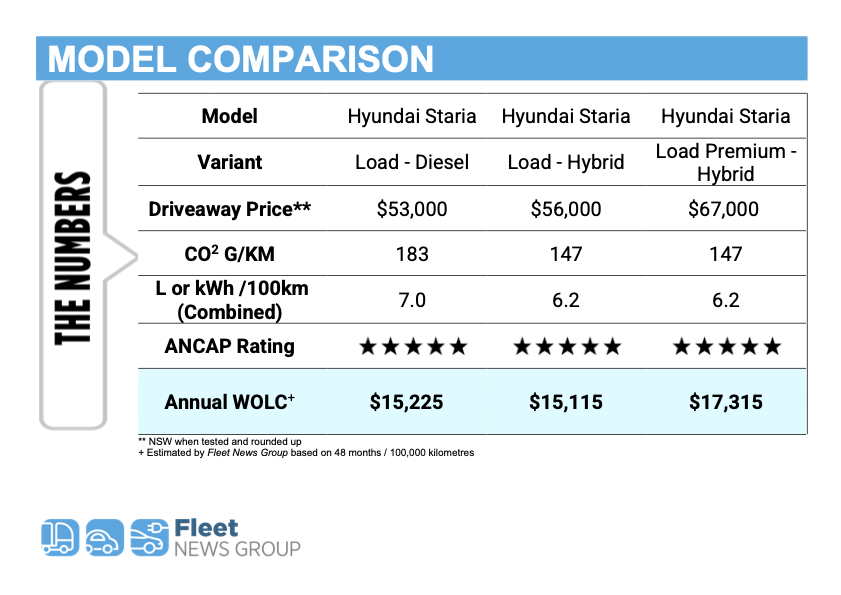
Fleet News Group’s WOLC model, based on 48 months and 100,000 kilometres, compares three variants in the range.
| Model | Drive-away Price | Annual WOLC |
|---|---|---|
| STARIA Load Diesel | $53,000 | $15,225 |
| STARIA Load Hybrid | $56,000 | $15,115 |
| STARIA Load Premium Hybrid | $67,000 | $17,315 |
Despite a $3,000 higher purchase price, the STARIA Load Hybrid records a slightly lower annual whole-of-life costthan the diesel.
The Premium Hybrid naturally carries a higher annual cost because buyers are paying for additional comfort, technology and convenience features rather than simply a different powertrain.
Fuel consumption tells only part of the story
On paper, the difference in published fuel consumption appears relatively modest.
- Diesel: 7.0L/100km
- Hybrid: 6.2L/100km
That equates to an 11.4% reduction in fuel consumption.
Assuming similar fuel prices, fleets should expect fuel expenditure to fall by approximately the same percentage. If the hybrid is regularly filled with lower-priced unleaded petrol while the diesel uses a more expensive diesel fuel, the operating cost advantage can become even greater, depending on market fuel prices.
Over a fleet covering 25,000km each year, that saving steadily contributes to reducing the hybrid’s higher purchase price.
The real sustainability benefit is carbon
Where the hybrid really begins to separate itself from the diesel is in carbon emissions. Many Fleet Managers focus solely on litres per 100 kilometres, but every litre of fuel burned produces a different amount of carbon dioxide.
As a rule of thumb:
- One litre of petrol produces approximately 2.3kg of CO₂
- One litre of diesel produces approximately 2.7kg of CO₂
Using Hyundai’s published fuel consumption figures:
Diesel
- 7.0L/100km × 2.7kg = 18.9kg of CO₂ per 100km
Hybrid
- 6.2L/100km × 2.3kg = 14.3kg of CO₂ per 100km
That represents a 24.6% reduction in tailpipe CO₂ emissions based on fuel burned.
This demonstrates why fuel economy alone doesn’t tell the whole sustainability story. The hybrid not only uses less fuel, it also burns a fuel that produces less carbon dioxide per litre.
Hyundai’s official ADR testing reflects this advantage. The diesel is rated at 183g/km of CO₂, while the hybrid produces 147g/km, a reduction of almost 20% under the official test cycle.

Sustainability without changing operations
For many fleets, moving directly to battery-electric vehicles is not yet practical because of charging infrastructure, operating patterns or towing requirements.
The STARIA Load Hybrid offers another pathway.
Drivers continue to refuel in the same way, operating procedures remain largely unchanged and there is no requirement for charging infrastructure. Yet fleets can still achieve measurable reductions in fuel consumption and carbon emissions.
For organisations with environmental reporting obligations or corporate sustainability targets, these reductions can accumulate quickly across a large fleet.
Looking beyond purchase price
It’s easy to dismiss the hybrid because of its higher acquisition cost.
However, WOLC analysis demonstrates why fleet managers should resist making purchasing decisions based solely on the invoice price.
The hybrid’s lower fuel consumption helps offset the additional capital cost over time, resulting in an annual whole-of-life cost that is slightly lower than the diesel in Fleet News Group’s modelling.
When the reduction in CO₂ emissions is added to the equation, the business case becomes stronger.
Fleet verdict
For fleets whose primary objective is the lowest purchase price, the diesel remains an attractive option, particularly if towing capability is required.
However, for organisations balancing financial performance with sustainability objectives, the STARIA Load Hybrid presents a compelling proposition.
The purchase price is higher, but over the ownership period much of that premium is recovered through lower fuel costs. More importantly, the combination of improved fuel efficiency and petrol’s lower carbon intensity delivers a meaningful reduction in greenhouse gas emissions.
In other words, the hybrid’s value proposition isn’t built on fuel savings alone. The real benefit is achieving lower operating costs while making measurable progress towards fleet sustainability goals.
- For Allianz, EVs are now business as usual
 For many organisations, fleet electrification still means pilots, trials and discussions about what might happen next. At Allianz, the conversation has moved on. After starting its transition with a small pilot of 12 vehicles two years ago, the insurer has reached the point where electric vehicles are becoming part of its normal fleet replacement process.
 - A Charger That Powers Up Isn’t Finished: Why Commissioning Matters for Fleet EV ChargingAn EV charger can be installed, connected and apparently operating — and the charging system can still be wrong. That is one of the more important lessons from the Local Council EV Integration Project involving Wyndham, Brimbank and Moonee Valley councils. As fleet charging installations become larger, depots are adding not only chargers but load
- How to Install EV Charging Without Shutting Down the DepotBuying electric vehicles may be the visible part of fleet electrification, but much of the hard work can happen underground. Trenching, conduits, electrical upgrades, switchboards, charger foundations, communications, traffic management and electrical shutdowns all need to be completed while the depot continues doing its normal job. Experience from the Local Council EV Integration Project involving
- Design the Depot Once: Future-Proofing EV Charging for the Fleet You’ll Have LaterFleet electrification rarely happens in one hit. Passenger vehicles may move first, followed by light commercial vehicles and, as suitable products become available, trucks and other specialised equipment. That creates a challenge for depot charging: how much infrastructure should a fleet build today for vehicles it may not purchase for several years? The Local Council EV
- Kinetic Turns Heatherton Into an Electric Bus HubKinetic has completed a major charging infrastructure upgrade at its Heatherton bus depot in Melbourne’s south-east, paving the way for every urban route bus operating from the site to become zero-emission by the end of 2026. The project increases the depot’s electric bus charging capacity from 12 vehicles to 30, allowing the site to support