
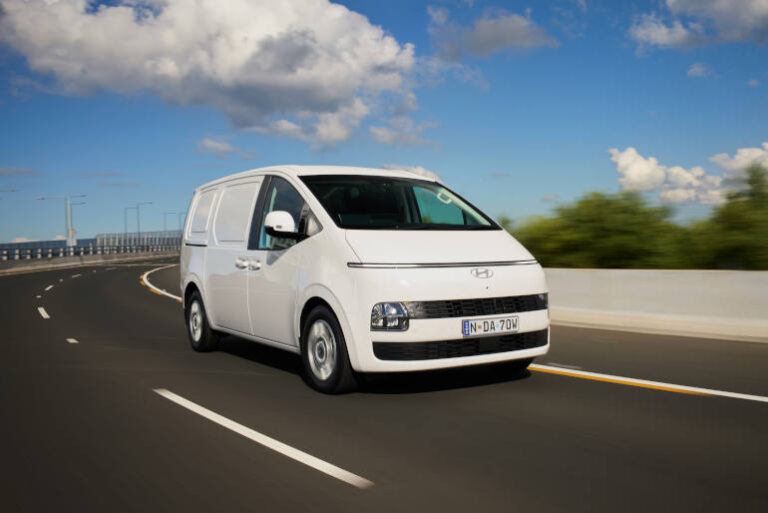
The numbers are close, but a whole-of-life cost comparison between the Hyundai STARIA Load and Toyota HiAce gives the Hyundai hybrid a narrow yet meaningful advantage.
Based on Fleet News Group estimates over 48 months and 100,000 kilometres, the STARIA Load Hybrid records the lowest annual whole-of-life cost at $15,115. It is followed closely by the STARIA Load Diesel at $15,225, while the Toyota HiAce LWB reaches $15,525 a year.
| Model | STARIA Load Diesel | STARIA Load Hybrid | Toyota HiAce LWB |
|---|---|---|---|
| Driveaway price | $53,000 | $56,000 | $60,000 |
| Combined fuel consumption | 7.0L/100km | 6.2L/100km | 7.8L/100km |
| CO₂ emissions | 183g/km | 147g/km | 194g/km |
| Annual WOLC | $15,225 | $15,115 | $15,525 |

A narrow cost advantage
The STARIA Load Hybrid costs $3,000 more to purchase than the diesel model, but its lower fuel use allows it to recover that initial disadvantage during the operating period.
Its annual WOLC is $110 lower than the STARIA Load Diesel and $410 lower than the HiAce. Across four years, that equates to an estimated advantage of $440 over the diesel Hyundai and $1,640 over the Toyota.
These are not enormous differences in the context of a fleet vehicle’s total operating cost. However, the hybrid’s advantage becomes more significant when emissions are included in the assessment.
Fuel consumption is only part of the equation
The STARIA Load Hybrid uses a claimed 6.2L/100km, compared with 7.0L/100km for the diesel STARIA Load and 7.8L/100km for the diesel HiAce.
That makes the hybrid’s fuel consumption approximately 11 per cent lower than the STARIA diesel and 21 per cent lower than the HiAce.
For fleets focused only on litres consumed and fuel expenditure, that improvement is useful but may not appear transformative. The more important result is found in the official grams-per-kilometre figures.
The hybrid produces 147g/km of CO₂, compared with 183g/km for the STARIA Load Diesel and 194g/km for the HiAce. It therefore delivers almost 20 per cent lower tailpipe emissions than the diesel STARIA and approximately 24 per cent lower emissions than the Toyota.
Petrol and diesel do not produce the same result
The difference between fuel consumption and CO₂ reduction is partly explained by the carbon content of the fuels.
Burning one litre of petrol produces approximately 2.3kg of CO₂, while one litre of diesel produces about 2.7kg. Diesel may deliver strong energy efficiency, but each litre consumed produces more carbon dioxide.
The STARIA Load Hybrid benefits from both sides of the equation. Its electrified powertrain reduces the amount of fuel used, particularly in stop-start driving, while the petrol it consumes produces less CO₂ per litre than diesel.
This is why comparing vans solely by their combined L/100km figures does not provide the complete picture. A relatively modest reduction in fuel consumption can translate into a substantially larger reduction in reported tailpipe emissions.
Tonnes of CO₂ removed from fleet totals
At 25,000 kilometres a year, the published emissions figures equate to approximately:
- 3.68 tonnes of CO₂ for the STARIA Load Hybrid
- 4.58 tonnes for the STARIA Load Diesel
- 4.85 tonnes for the HiAce
Over the 100,000-kilometre WOLC period, the hybrid would produce approximately 14.7 tonnes of tailpipe CO₂. That is 3.6 tonnes less than the diesel STARIA and 4.7 tonnes less than the HiAce.
Multiplied across a fleet of 20 vans, choosing the hybrid instead of the HiAce could reduce reported tailpipe emissions by approximately 94 tonnes over four years, based on the official figures.
A stronger result for fleet sustainability targets
The STARIA Load Hybrid is not a zero-emission vehicle, and its suitability will still depend on payload, operating conditions and application requirements. However, it provides fleets with a way to reduce emissions without depending on charging infrastructure or requiring drivers to change their daily routines.
That matters for organisations operating under net-zero strategies, government emissions mandates or corporate carbon-reduction targets. Fleet decisions increasingly need to consider more than acquisition price and fuel expenditure. Every vehicle added to the fleet also contributes to the organisation’s emissions inventory for several years.
The WOLC comparison shows that the three vans are relatively close financially. The STARIA Load Hybrid’s winning edge is that it combines the lowest estimated annual cost with the lowest fuel consumption and, more importantly, the lowest CO₂ output.
For fleets trying to lower both operating expenses and emissions, that makes the hybrid’s narrow WOLC victory much more significant than the dollar difference alone suggests.