


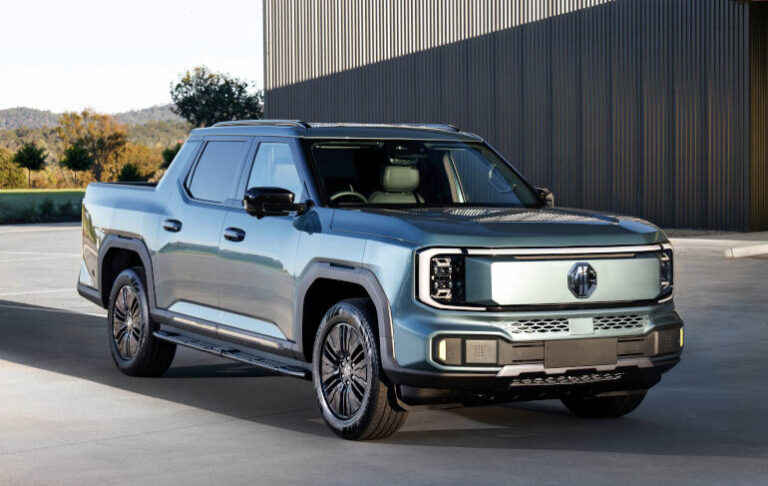
Australia will be the first market in the world to receive MG’s new all-electric MGU9 EV, giving fleet operators another option as manufacturers begin pushing battery-electric vehicles into the ute segment.
MG Motor Australia says the MGU9 EV has been designed and tested for Australian conditions, combining dual-motor all-wheel drive with a 102.2kWh LFP battery, 430km WLTP driving range and 3,500kg braked towing capacity.
Those numbers immediately make the MGU9 interesting for fleets assessing whether an electric ute can move beyond metropolitan passenger-style duties.
The dual-motor powertrain produces 325kW and 700Nm, with MG claiming a 0–100km/h time of 5.8 seconds.
But for fleet buyers, acceleration is likely to be less important than whether the vehicle can carry equipment, tow trailers, complete a full working day and recharge without creating operational problems.
MG targets everyday ute use
MG describes the MGU9 EV as a lifestyle ute rather than positioning it solely as a commercial workhorse.
Dimitri Andreatidis, Marketing Director at MG Motor Australia, said the vehicle had been developed around the way Australians use their utes.
“The MGU9 EV brings together the capability and utility people expect from a ute with the comfort and benefits of an electric powertrain.”
Andreatidis said MG expects customers to use the vehicle across work, family and recreational duties, with Australia being the first global market to launch it.
That positioning could also suit organisations where utes perform mixed roles — travelling between offices and sites during the week while carrying equipment or towing occasionally.
The MGU9 EV has a 236-litre front storage compartment, while MG says the rear tub can accommodate a standard pallet. Its listed payload is 685kg, an important number for fleet managers to consider when assessing vehicle suitability alongside towing requirements.
V2L could have genuine fleet applications
One specification likely to attract attention from operational fleets is the MGU9 EV’s vehicle-to-load capability.
The vehicle can provide up to 6.6kW through its external CCS2 connection, with three additional 2.2kW outlets available inside the cabin.
For trades, maintenance crews, utilities and field-service operations, that creates the potential to run tools and other equipment directly from the vehicle rather than carrying a separate generator or portable power source.
V2L is becoming an increasingly relevant part of the fleet EV conversation because it changes the vehicle from simply being transport into a mobile energy source.
Charging will be part of the fleet equation
The MGU9 EV supports 11kW AC charging, while its maximum DC charging rate is 115kW. MG says a 20–80 per cent DC charge takes approximately 42 minutes.
For fleet operators, the relatively large 102.2kWh battery reinforces the importance of matching charging infrastructure to the vehicle’s daily utilisation.
Vehicles returning to a depot overnight should be well suited to AC charging, while organisations expecting drivers to rely regularly on public DC infrastructure will need to factor charging time and charger availability into route planning.
The claimed 430km WLTP range provides a useful starting point, although real-world range will inevitably depend on load, towing, speed, weather and operating conditions.
Capability comes with passenger-car comfort
MG has also loaded the MGU9 EV with equipment normally associated with passenger vehicles.
It features four-wheel electronic air suspension, dual 12.3-inch displays, wireless Apple CarPlay and Android Auto, leather front seats, wireless phone charging and an eight-speaker JBL audio system. The driver’s seat is heated, ventilated and includes massage functionality, while the passenger seat and steering wheel are also heated.
A 360-degree camera, hands-free automatic tailgate and five-star ANCAP safety rating are also included.
Meng Chen, Head of Product at MG Motor Australia, said the objective was to remove some of the traditional compromises associated with moving from an internal-combustion ute to an electric model.
“It gives customers the option to move to an electric ute without giving up the utility and flexibility they expect from the segment.”
Another electric ute for fleets to assess
For fleets, the arrival of the MGU9 EV is significant because electric utes are starting to provide specifications that are easier to compare with conventional vehicles.
A 3.5-tonne towing rating, 430km WLTP range, AWD, V2L and a pallet-capable tub address several of the questions fleet managers have traditionally raised about electric commercial vehicles.
The 685kg payload and 115kW maximum DC charging rate will need to be considered against individual duty cycles, particularly for vehicles carrying heavy equipment or travelling long distances.
The real fleet test will come when pricing, whole-of-life costs and real-world energy consumption are considered alongside those operational requirements.
What MG has provided, however, is another indication that the Australian electric ute market is moving beyond the question of whether an EV can offer meaningful capability and towards the more practical question for fleets: which jobs can it actually do?