
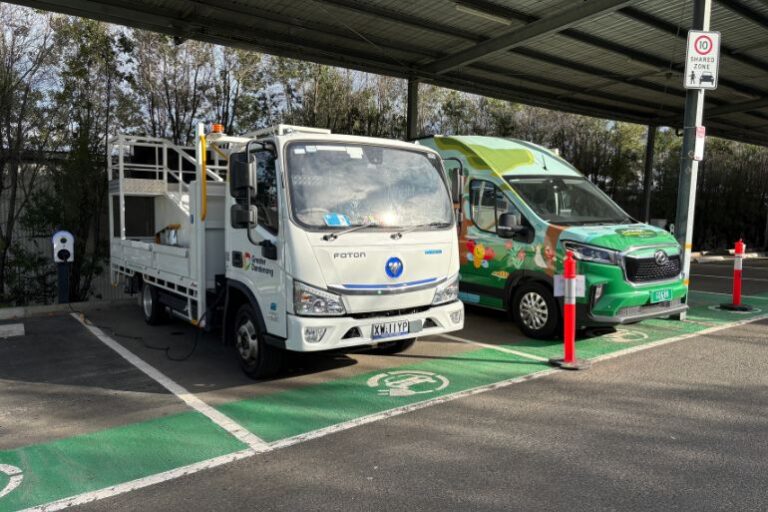
Electric trucks are becoming part of everyday service delivery at Greater Dandenong council, with five vehicles introduced to support its transition to lower-emission operations.
The trucks sit alongside four electric vans and a passenger fleet in which council reports 76% of cars have been replaced with hybrid or electric alternatives. Council has committed to replacing all passenger cars with low-emission alternatives by 2030.
For Mark Hall, Team Leader Fleet and Operations Centre Services, selecting an electric truck starts with understanding the work it needs to perform.
A practical job for an electric truck
The council’s Foton electric sign truck replaced a small diesel Hino 300 Series. It carries the crew, tools and equipment needed to repair street and road signs, with an enclosed body providing storage and working access.
Hall estimates the truck travels more than 50 kilometres a day and can cover around 200 kilometres on a full charge, depending on load and operating conditions.
For that workload, he says, charging may only be necessary two or three times a week.
The relatively compact operating area helps make the application manageable. Vehicles undertake local work and return to a depot, giving the council an opportunity to match charging with their operating schedules.
Hall recognises that the same truck may be unsuitable for a regional council travelling 250 kilometres a day. Distance, load and access to charging need to be considered together.
Looking beyond the powertrain
The sign truck’s replacement also brought improvements to the body, including more space for equipment.
Those changes could have been made on a diesel replacement too. The electric chassis still needed to demonstrate that it could meet the operational requirement.
Hall’s assessment of electric trucks has included vehicle testing, towing requirements and purchasing arrangements. Greater Dandenong owns its fleet, making the availability of vehicles for purchase a consideration during the selection process.
Supplier support is another priority.
“The big thing for me is support.”
That means considering who will maintain the vehicle, where parts will come from and how the supplier can respond when something goes wrong.
For Fleet Managers assessing an unfamiliar brand, those questions form part of understanding the risk to service delivery.
Designing around the crew
The council’s electric tippers demonstrate how body design can evolve through experience.
After using an earlier truck, the team requested a larger toolbox for a subsequent build. That meant accepting less tray space in return for more lockable, weatherproof storage.
The decision reflected how the truck would be used. Carrying tools and equipment was a significant requirement, making storage a priority.
The council has also been developing separate auxiliary battery systems to charge battery-powered tools. Rooftop solar supports these systems, with a connection to the trucks’ 24-volt batteries also forming part of the arrangement.
The solar panels support auxiliary equipment rather than charging the traction battery.
Hall says the requirement generally involves two or three tool batteries a day. The installations have been developed in-house with assistance from a skilled contractor and are being assessed through use.
Building confidence through experience
Hall reports positive driver feedback on the electric trucks, including their comfort and driving characteristics.
The council has specified practical additions such as seat covers and aftermarket Apple CarPlay to support everyday use.
Electrification remains selective. Operating cycles and purchase costs have restricted some electric plant applications, and diesel continues to be purchased where required.
Greater Dandenong’s approach gives Fleet Managers a useful starting point: identify a suitable task, assess the complete vehicle and use operational experience to improve the next replacement.