


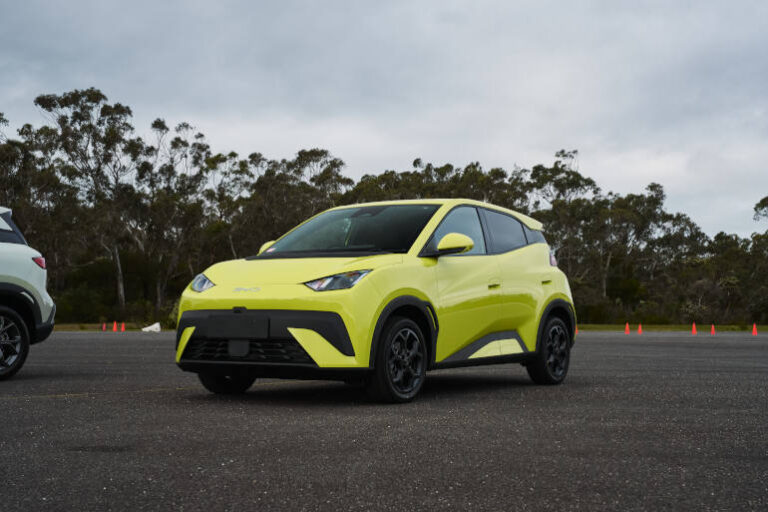
BYD has confirmed that its newest compact EV, the BYD ATTO 1, has achieved a maximum five-star ANCAP safety rating — a result that will immediately attract the attention of Fleet Managers, Sustainability Managers, and Finance Managers planning their next round of vehicle replacements.
In a market where safety, efficiency, and affordability are all under scrutiny, the ATTO 1 enters Australia as one of the safest electric vehicles tested, backed by strong crash-protection scores and an unexpectedly comprehensive driver-assistance suite for a compact EV priced from just $23,990 plus on-roads.
For organisations planning EV adoption, this rating puts the ATTO 1 firmly on the radar as a high-value, low-emission city-fleet option that still meets strict corporate safety standards.
Five Stars Across Both Variants
ANCAP’s five-star rating applies to both ATTO 1 variants, confirming the strength of the platform regardless of battery or equipment level.
The results include:
- 82% Adult Occupant Protection
- 86% Child Occupant Protection
- 76% Vulnerable Road User Protection
- 79% Safety Assist
These scores reflect robust structural design and a safety technology package that outperforms many vehicles at significantly higher price points.
BYD Australia COO Stephen Collins welcomed the result, saying:
“Safety is fundamental to BYD’s mission, so we’re pleased to see the ATTO 1 recognised at the highest level by ANCAP.”
He added:
“This rating further cements our commitment to delivering world-class vehicles that combine leading technology, exceptional value, and uncompromising protection for drivers, passengers, and all road users.”
Advanced Safety Suite as Standard — A Signal to Fleet Buyers
The ATTO 1 ships with an unusually comprehensive list of active safety technologies for an entry-level EV. For fleets that require ANCAP five-star compliance, driver-monitoring technology, and robust active safety as part of their duty-of-care framework, the ATTO 1 ticks a lot of boxes without requiring optional packs.
Standard features include:
- Autonomous Emergency Braking (AEB)
- Lane Departure Assist (LDA)
- Emergency Lane Keeping Assist (ELKA)
- Intelligent Speed Limit Control (ISLC)
- Forward Collision Warning (FCW)
- Tyre Pressure Monitoring System (TPMS)
- Direct Driver-Monitoring System
This last inclusion — a camera-based driver-monitoring system — is particularly relevant for fleets navigating Chain of Responsibility, duty-of-care requirements, or corporate safe-driving policies. Systems like this are often reserved for premium models, not compact EVs under $25k.
These safety inclusions support organisations aiming to reduce crash frequency, improve insurance performance, and deliver safer outcomes for staff travelling in dense metro environments.
Strong Results in Crash Testing and AEB Scenarios
ANCAP awarded maximum points in several key areas:
- Side-impact protection
- Oblique pole test
- Whiplash protection
Importantly for fleet urban-use cases, the ATTO 1 performed strongly in AEB testing across:
- Car-to-car
- Pedestrian
- Cyclist
- Motorcycle
- Junction and crossing scenarios
This broad AEB coverage gives Safety and Sustainability Managers confidence that the vehicle supports risk-mitigation strategies across varied urban-fleet tasks — from field-service vehicles to commuter-car pools and last-mile support roles.
Why This Matters for Fleet and Sustainability Planning
1. A Sub-$25k EV With Five-Star Safety Changes Procurement Math
For Finance Managers, TCO modelling is more favourable when EV purchase prices come down. A five-star, sub-$25k EV fundamentally alters the entry point for organisations piloting EV programs or scaling beyond early adopters.
With BEV prices trending downward and running costs far lower than equivalent ICE vehicles, the ATTO 1 could become a popular choice for fleets overseeing large pools of city cars or multi-driver vehicles.
2. Safety Tech Accelerates Policy Compliance
For organisations with:
- mandatory ANCAP requirements
- digital driver-monitoring policies
- fatigue-management frameworks
- CoR-related safe-operation standards
…the ATTO 1 offers compliant tech with no optional packages required.
This simplifies policy alignment and reduces variation in fleet configuration.
3. Emissions Reduction Without High Capital Outlay
Sustainability Managers often face the hurdle of high EV purchase prices when building decarbonisation roadmaps.
A compact EV at ATTO 1 pricing enables:
- low-risk pilot programs
- early transition of high-utilisation metro vehicles
- simplified home-charging or onsite AC charging deployment
- meaningful early emissions reduction at scalable cost
When paired with low servicing needs and strong residual value outlooks for EVs, the ATTO 1 becomes an attractive early electrification candidate.
Fleet procurement teams now have a realistic BEV option that doesn’t compromise safety for affordability — an important change as NVES brings more low-emission models to the market.