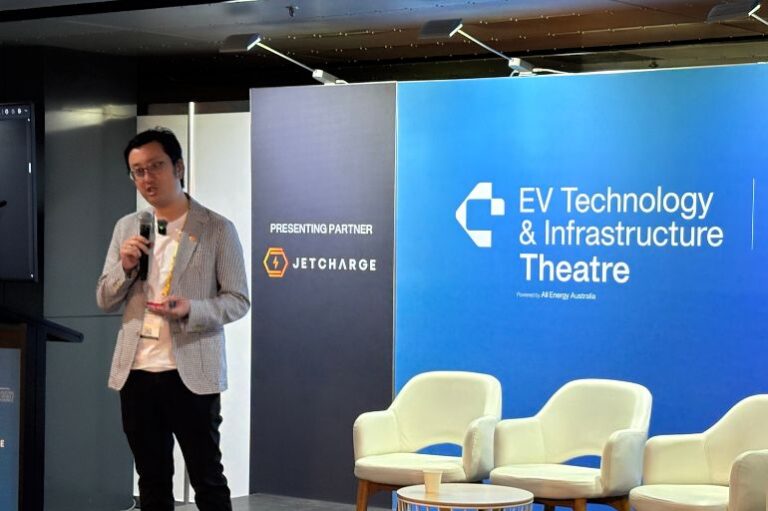
Tim Washington, Co-Founder and CEO of JET Charge, delivered a candid and forward-looking presentation on the realities of scaling EV charging infrastructure in Australia. Speaking with his characteristic openness, Washington reflected on the company’s 12-year journey—from early home-charging installations to today’s involvement in large-scale fleet, bus and truck electrification—and shared the lessons other businesses can use to build stronger and more resilient charging operations.
The Scale of the Challenge
Washington highlighted the enormity of Australia’s electrification task. To hit national emissions targets by 2035, Australia must grow from 400,000 EVs to around 5 million—a 17-fold increase within a decade. Public charging alone must expand from 4,000 DC plugs to around 60,000, even though public infrastructure serves only 30% of charging demand.
His key message: no single company can meet this challenge alone, and the industry must attract and support a new generation of charging businesses.
Lesson 1 — Collaboration Over Arrogance
Washington admitted that JET Charge’s early belief that it could “do everything”—project management, hardware, software—was a mistake. The realisation:
“This is not something any one company can do on their own.”
To reach national targets, more players must enter and grow the EV charging industry, and incumbents must actively support that growth.
Lesson 2 — No Single Hardware Brand Fits All
As the market grows more complex, Washington stressed that installers and solution providers must avoid tying themselves to a single hardware manufacturer. Jet Charge now partners with multiple brands because:
“Our customer is the customer—not the supplier.”
Lesson 3 — Load Management Will Define Future Projects
As sites move from a handful of chargers to 30, 40 or even 100 units, load management becomes essential. Businesses that fail to master these systems will be locked out of large-scale deployments.
Lesson 4 — Software Is Non-Negotiable
Washington warned that companies that limit themselves to electrical work and ignore software “will not succeed.”
Key points:
- The era of “all-in-one” software is fading.
- The market will shift to specialised platforms for specific tasks (e.g., fleet, public charging, asset management, grid integration).
- Integration skills will become a competitive advantage.
- Critical infrastructure clients are increasingly demanding data sovereignty and local software development, which many white-label platforms cannot meet.
Lesson 5 — Evolving Business Models
Beyond supplying and installing chargers, Washington highlighted the importance of new models such as Charging-as-a-Service (CaaS). JET Charge moved into this space later than it should have, and he encouraged businesses to consider alternative commercial models early.
Lesson 6 — Customers Are Getting Smarter
EV buyers—especially fleets—now ask highly technical questions about:
- Dynamic tariffs
- Grid impacts
- V2G
- Wholesale market integration
- Storage and solar
Washington acknowledged JET Charge took too long to build its internal knowledge base—and urged new entrants not to repeat that mistake.
Lesson 7 — Don’t Get Caught in the Hype (Especially V2G)
Washington openly described his own “FOMO” over early V2G pilots, admitting Jet Charge invested ahead of the market’s readiness. While V2G is “almost here”—with regulatory barriers removed and OEM interest growing—he warned against building an entire business around early-stage technologies.
However, V2G remains central to JET Charge’s long-term mission:
“With V2G, we can make EV charging free.”
Final Message
Despite the challenges, Washington emphasised that EV charging is one of the most attractive, meaningful, and high-growth industries in Australia. To meet 2035 emissions goals, the market must deploy:
- 30 DC chargers every day, and
- Hundreds of AC chargers per day for the next decade.
His closing advice:
- Learn from his mistakes.
- Build better, faster, and with the right partners.
- Help grow the entire industry—because no single business can meet Australia’s electrification challenge alone.