


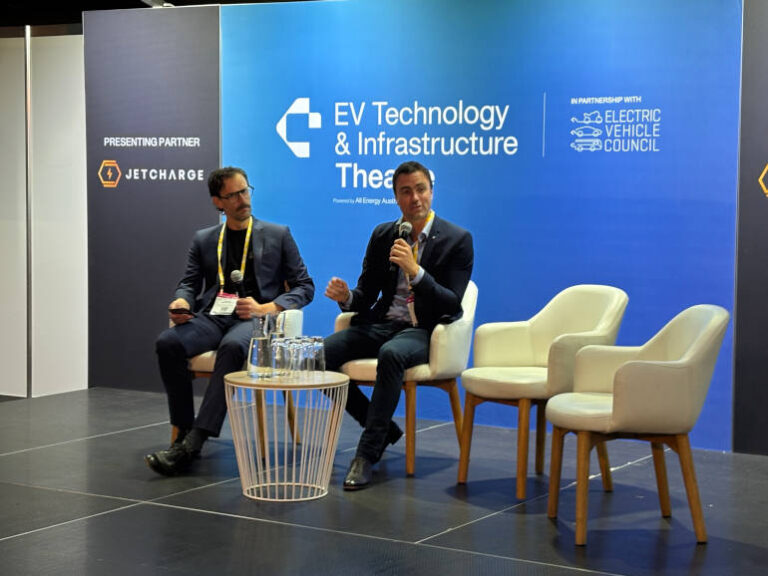
When Edward Kocwa, CEO of BOSSCAP Group, stepped onto the stage at All Energy 2025, the message was clear: Australia’s heavy-duty EV transition isn’t waiting for OEMs to catch up — BOSSCAP is building it now. And the centrepiece is the Ford F-150 Lightning, converted to right-hand-drive in Queensland and already proving its capability on mining and construction sites.
The session delivered one of the most compelling case studies yet of how an imported EV can be engineered for Australian conditions, turned into a fit-for-purpose workhorse, and deployed at scale into harsh, remote fleet environments.
A Strategic Pivot: From Diesel Pickups to Electric Workhorses
Kocwa opened by explaining that BOSSCAP wasn’t always an EV specialist. The business previously made its money importing and remanufacturing large American diesel pickups — RAM TRXs, Dodge performance models, heavy-duty utes for grey-nomad towing. But by 2022, Kocwa made a decisive call to pivot the company away from retail customers and toward fleet and mining electrification.
“I could see nothing coming to market that would do the jobs required for mining,” he said.
“Fleets in Australia needed to be taken care of, and for too long the big dealer networks just hadn’t provided the level of service required.”
After a global search for suitable platforms, BOSSCAP settled on the Ford F-150 Lightning — not because it was easy, but because it was proven.
The F-150 is the world’s best-selling vehicle, trusted by US defence, emergency services, and backed by decades-deep parts supply. More importantly, its electric platform offered the payload, range and durability mining operations demand.
BOSSCAP now imports the Lightning, then sends it to its own engineering division — Advanced Manufacturing Queensland — where it is converted to right-hand-drive, re-engineered with a CCS2 charge port, and upfitted for fleet and mining specifications. The company now does similar RHD conversions for Hyundai’s hydrogen fuel-cell truck.
Why the F-150 Lightning Works for Mining Fleets
Kocwa said the decision ultimately came down to real-world performance.
- 1.4-tonne payload
- Up to 500 km range, even in harsh use
- A 144 kWh usable battery, larger than advertised
- Modular body design that allows trays and specialist bodies — something upcoming EV utes struggle to offer
- DC-based vehicle-to-load (V2L) delivering 3-phase 32A power
For mining companies, that combination matters. Utes aren’t just transport — they are mobile power sources, workplace tools and safety equipment carriers. The ability to deliver true high-load V2L has already changed the way mine sites think about energy management.
“We’ve got vehicles running serious equipment, not kettles,” Kocwa said. “We’re not underground yet — the risk profile is more complex — but they’re already being used across mine sites.”
V2X Is the Game-Changer for Total Cost of Ownership
While most EV conversations focus on range and charging, Kocwa was blunt: vehicle-to-everything (V2X) is the value multiplier fleets can’t afford to ignore.
He offered practical examples already in use:
1. Replacing diesel generators on remote mine sites
Lunch rooms (“dongas”) on remote operations currently use portable diesel gensets. A single F-150 Lightning can run the entire donga — zero diesel deliveries, zero maintenance, zero noise.
“That donga can run 24/7,” Kocwa said. “The ute drives around during the day, charges elsewhere, and comes back. It’s a game changer.”
2. Silent, no-restriction power for construction sites
Some sites restrict generator operating hours because of noise. Contractors currently need both a generator and a stationary battery. The combined cost exceeds the price of a ute.
“The Lightning becomes the generator and the battery — and it can go home at night to recharge.”
3. Councils exploring revenue from energy export
Some local governments trialling the Lightning are now exploring energy arbitrage from V2G — a surprisingly strong total cost of ownership lever.
“When we model TCO, factoring in V2X is a game changer.”
Engineering for Australia: The CCS2 Conversion and Pilbara Testing
One question from the audience hit a key technical challenge: the Lightning arrives with US-standard CCS1 or NACS ports. BOSSCAP doesn’t use adapters — they completely convert the vehicle to CCS2.
“That’s the biggest job,” Kocwa admitted. “And what we realised is that charge performance at 20 or 30 degrees is very different to 55 degrees.”
So BOSSCAP conducted extended charge-rate testing in the Pilbara to ensure the Lightning can deliver peak charging even in extreme heat — something fleets expect, but few OEMs test for.
Driver Acceptance: ‘Everyone Has an Opinion — Then They Drive One’
Kocwa was candid about the reality of frontline adoption.
“You can’t just drop it off and leave it. You’ve got to hand-hold,” he said.
He shared a Pilbara example where a contractor swapped out Prados and delivered F-150 Lightnings to customers on remote sites. The first vehicle was rejected — “this piece of shit won’t charge” — only for BOSSCAP to discover the site’s only charger was RFID-locked by another operator.
That’s why BOSSCAP supplies clear charging instructions, integrates with charger back-ends, and supports every major AC and DC hardware brand.
Once the initial hurdles are cleared, Kocwa said drivers quickly convert.
“Everyone has an opinion — then they use it, and they change their mind.”
Fleet-First Strategy: No Retail Plans, All Mining
Kocwa made it clear: BOSSCAP isn’t chasing consumer sales.
“Our vehicle is $128,000 — not the $250,000 I see in the news — but we’re focused on fleets and mining.”
The company is building service and charging capability in remote locations, including:
- Land purchased in Karratha
- New base in Mackay
- Plans for mine-site charging under an OPEX model, enabling instant transition without upfront capex
“Our goal is to provide charging infrastructure for the mining sector. If we fund it as OPEX, fleets can switch instantly and start saving.”
The Manufacturing Debate: “We Can’t Be Just a Big Mine With No Industry”
Kocwa’s strongest message wasn’t technical — it was patriotic.
“I love seeing all this product here, but I hate the fact that none of it comes from here. We can’t keep going down this route for the next 10–20 years.”
He welcomed the Federal Government’s renewed “Made in Australia” push, but called out how inaccessible funding processes remain for small and medium businesses.
His appeal to the industry was simple: back Australian companies.
“Let’s give them a like, support them, get behind it. The Chinese backed their industry for 10 years and look at them now. We need the same patriotism.”
This Is the Prototype of Australia’s Heavy-Duty EV Transition
For councils, miners, utilities and contractors, BOSSCAP’s Lightning program demonstrates:
- A heavy-duty EV ute can be engineered for Australia today
- V2X is not a future concept — it’s already replacing generators
- Right-hand-drive conversion can be done locally with full fleet support
- Remote-area servicing is essential for fleet electrification
- Mining will lead the transition long before retail EV utes arrive
Kocwa’s final message: the opportunity is enormous — and it’s happening now.
“Everyone is aligned on V2G. It just makes sense. It’s not about saving the planet — it’s about flattening the peaks and saving everyone money.”