


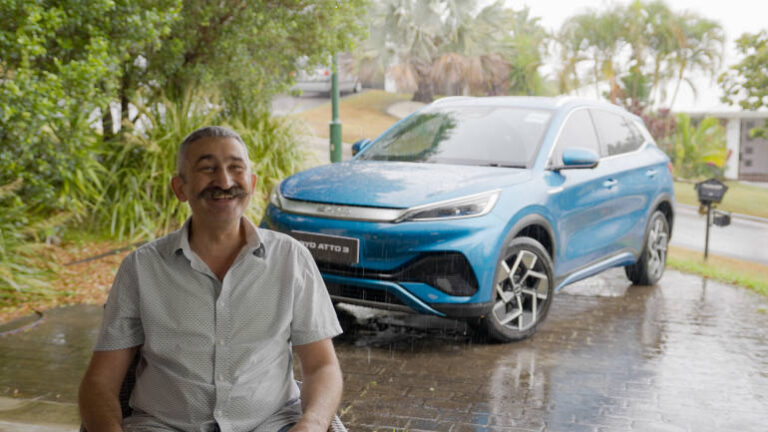
When a rideshare driver clocks up 200,000km in just two years, fleet managers take notice. Ammar Al-Kass, a Gold Coast-based Uber, DiDi and Amazon delivery driver, has become the first feature in EVDealer Group’s new short-form documentary series The Miles Driven—and his BYD ATTO 3 is the star of the story.
The case study offers rare, real-world data on high-utilisation EV operation. For fleets assessing long-term durability, brake wear, charging behaviour and cost savings, Ammar’s experience provides valuable insights backed by hard kilometres rather than theory.
A Workload That Mirrors Commercial Fleet Use
Ammar averages 1,700km each week, equivalent to the workload of a courier, mobile technician, council pool vehicle or health-service fleet car.
He confirms he recently passed the milestone:
“I have recently reached 200,000km and it has been reliable in that time.”
For fleet planners modelling duty cycles for EV transition, this level of continuous utilisation demonstrates the operational capability of modern EVs under commercial loads.
Minimal Brake Wear Shows the Advantage of Regeneration
One of the biggest questions asked by fleet operators is: How does an EV cope mechanically over hundreds of thousands of kilometres?
Ammar’s answer is remarkable:
“I also did 200,000km service last week, and they told me that I still have two millimetres on the original brake pads! And imagine 200,000km with the same brake pads!”
For fleets, this highlights the cost-efficiency of regenerative braking—less downtime, fewer replacement parts and smoother maintenance forecasting.
Charging Routine: Simple, Predictable, Overnight
Ammar relies on predictable overnight home charging using a 7kW AC wall unit.
“I usually charge my car every day at home using the seven kilowatt charger… usually, while I’m sleeping.”
He also programs charging to match next-day work patterns:
“I adjust the times I want the charge to start and finish… It just depends on when I’m going to start work the next day.”
For fleet managers, this mirrors depot-style charging—low effort, low cost, and easy to schedule.
Cost Savings: EV Economics That Matter to Finance Managers
Ammar previously spent $300–$350 per week on fuel in his petrol car. Switching to the ATTO 3 delivered immediate savings:
“This amount of money alone is now enough for the car loan and the electricity bill.”
This aligns with fleet TCO modelling where EVs outperform ICE vehicles once fuel and maintenance savings are included.
Driver Wellbeing: Less Fatigue, More Comfort
Long driving hours create fatigue risk—one of the most significant safety challenges fleets face.
Ammar describes a calmer, quieter cabin that reduces driver stress:
“It’s a really, quiet, smooth drive. I don’t feel any tension when I drive it. There is no engine noise or vibration.”
He also notes lower fatigue compared with petrol vehicles:
“When you drive for that amount of time… you don’t get tired because there’s no engine noise.”
For fleets operating long-shift vehicles, this directly supports WHS outcomes and driver satisfaction.
Passenger Feedback Highlights Interior Appeal
Rideshare passengers regularly comment on the BYD’s unique interior design:
“I still remember one of my passengers… she said, ‘I can’t stop looking at the inside of this car. It’s really amazing.’”
While this may seem cosmetic, it matters for customer-facing fleets—rideshare, community transport, corporate transport and health mobility services—where perceived quality influences service reputation.
Why He Chose BYD Over Toyota
Ammar originally sought another Camry but faced long delays:
“I would’ve had to wait over 8 months for the Toyota. So ultimately, I took the BYD.”
Fast delivery remains a major factor for fleets managing replacement cycles under NVES-driven product constraints.
Strong Endorsement for Future Fleet EV Buying
Ammar plans to stay electric:
“Of course. Yeah, I will buy another EV in the future.”
And—not surprisingly—he recommends BYD based on his experience:
“I’m always trying to convince the people to buy EV, especially with a BYD, because I love it.”
For procurement teams, endorsements from high-kilometre commercial users provide practical data that complements OEM claims.
What It Means for Fleet Managers
Ammar’s 200,000km journey shows:
1. EVs are capable of high-kilometre commercial use
Consistent reliability under heavy duty cycles supports fleet transition plans.
2. Maintenance costs are significantly lower
Brake pads lasting 200,000km are clear evidence.
3. Scheduled overnight charging suits fleet operations
Simple charging patterns support depot-based electrification.
4. Driver wellbeing improves
Quieter cabins reduce fatigue—an important WHS advantage.
5. EV TCO benefits are real and measurable
Fuel savings alone can offset vehicle finance and charging costs.
A Story That Resonates Across the Fleet Sector
EVDealer Group National Marketing Manager Sammie Brackin described Ammar’s achievement as representing the values of the brand:
“His achievement is truly remarkable and sets the tone for what this series is all about.”
For Australian fleets planning their next round of EV procurement, Ammar’s experience provides something rare—evidence at scale.
High-kilometre, real-world EV performance data is one of the missing pieces in many fleet transition plans. This case study helps fill that gap.




