

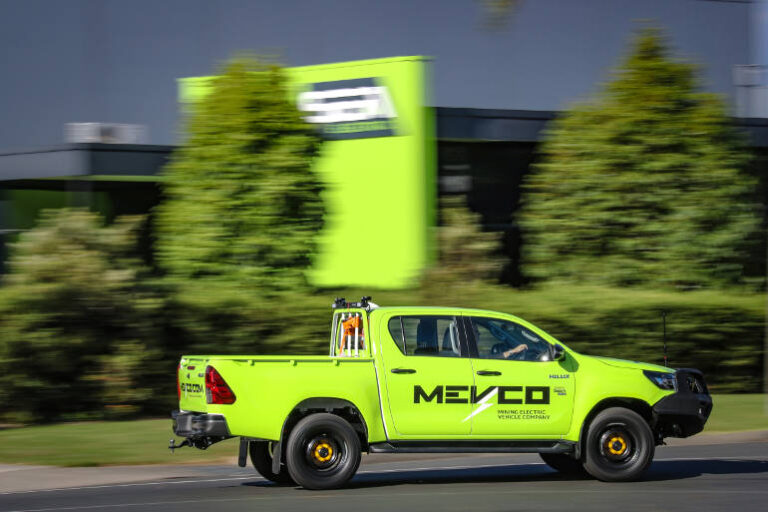
For more than five years, Australia’s fleet market has been captivated by one recurring promise — the electric Toyota Hilux and Landcruiser. The idea of an all-electric 4×4 ute, tough enough for the mine site yet clean enough for corporate ESG goals, sparked a frenzy of enthusiasm and headlines that bordered on hysteria.
It started with a simple dream: take the most popular vehicle in the country, remove the diesel engine, and replace it with a battery-electric drivetrain. For mining fleets under pressure to decarbonise and companies chasing Scope 1 and 2 emission reductions, this concept seemed almost too good to be true — and in many ways, it was.
The conversion gold rush
In 2021, GB Auto, based in Orange, New South Wales, became one of the first to make headlines, signing a deal with Dutch company Tembo e-LV B.V. and VivoPower PLC to convert Toyota Hilux and Landcruiser models for underground mine use. The partnership was ambitious — 2,000 electric conversions over four years, an estimated US$250 million in value, and plans for micro-grid integration to charge vehicles using renewable power.
Then, in early 2023, MEVCO emerged as the next major player, partnering with SEA Electric to deliver 8,500 electric Hilux and Landcruiser models over five years — a deal valued near AU$1 billion. Backed by Resource Capital Funds’ innovation arm, RCF Jolimont, the venture carried all the hallmarks of a serious push to electrify the mining industry.
In a LinkedIn post that went viral in December 2022, MEVCO CEO Matt Cahir wrote:
“I have 38 Electric Toyota Hilux trucks with full mine spec available for delivery in Australia.”
It was the post that broke the internet — at least in fleet circles. Fleet Managers, particularly in the mining and resources sector, flooded the company with enquiries. The prospect of a ready-to-deliver, mine-spec electric Hilux was irresistible.
The promise and the pitfalls
The prototypes were impressive — quiet, powerful, and rugged. The SEA-Drive® system offered 88 kWh or 60 kWh battery options with ranges up to 380 km and DC fast-charging to 80 % in under an hour. There was talk of health and safety benefits from reduced noise and heat, and claims that the vehicles would save tonnes of CO₂ per year.
Yet beneath the enthusiasm lay the complex realities of converting vehicles originally designed for internal combustion. Certification hurdles, warranty limitations, and funding challenges quickly became barriers. Despite strong customer interest, none of the companies could sustain large-scale production.
Roev, another Australian start-up, announced plans in 2022 to convert existing Toyota Hilux and Ford Ranger utes to electric, touting vehicle-to-grid technology and local manufacturing aspirations. By mid-2024, however, Roev had discontinued its vehicle program, citing funding shortfalls and pivoting to fleet-transition software instead.
The tipping point — and Toyota’s timing
MEVCO’s entry into liquidation in late 2025, barely two years after its high-profile launch, marks an ironic turning point. Just as the company’s ambitious conversion venture winds down, Toyota has confirmed that it will launch a factory-built battery-electric Hilux in Australia in 2026, targeting fleet buyers first.
The timing is uncanny. For years, conversion specialists filled a void created by the absence of a genuine OEM electric ute. Now, with Toyota’s BEV Hilux on the horizon — alongside growing electrification efforts from other brands — that void is finally being addressed at scale and with full manufacturer support.
Lessons for the fleet industry
The electric-conversion era demonstrated one undeniable truth: demand exists. Fleet Managers, particularly in mining and heavy industry, were desperate for a fit-for-purpose, zero-emission 4×4. They were ready to place orders long before any major OEM could deliver.
But it also exposed the limits of enthusiasm without infrastructure and capital. Converting diesel utes into electric ones was technically feasible but commercially fragile. Scaling up required supply chains, warranties, and long-term investor confidence — elements only a global manufacturer like Toyota could sustain.
From hype to heritage
The flurry of activity from GB Auto, Roev, and MEVCO wasn’t wasted effort. These early ventures proved the market potential, validated technical solutions, and sent a clear message to the world’s largest carmaker that Australia’s fleets were ready for electrification — if only someone could build it at scale.
Now, with the factory-built BEV Hilux expected to arrive in 2026, the cycle comes full circle. The conversions showed what was possible; Toyota’s move shows what’s sustainable.
For Fleet Managers, the lesson is clear — the hype was justified, but the timing was early. The next chapter in Australia’s electric-ute story will be written not in workshops retrofitting diesel chassis, but on production lines building electric utes purpose-designed for the job.
In the end, MEVCO’s story may not be a cautionary tale — but rather the necessary spark that pushed the industry from hype to history.