

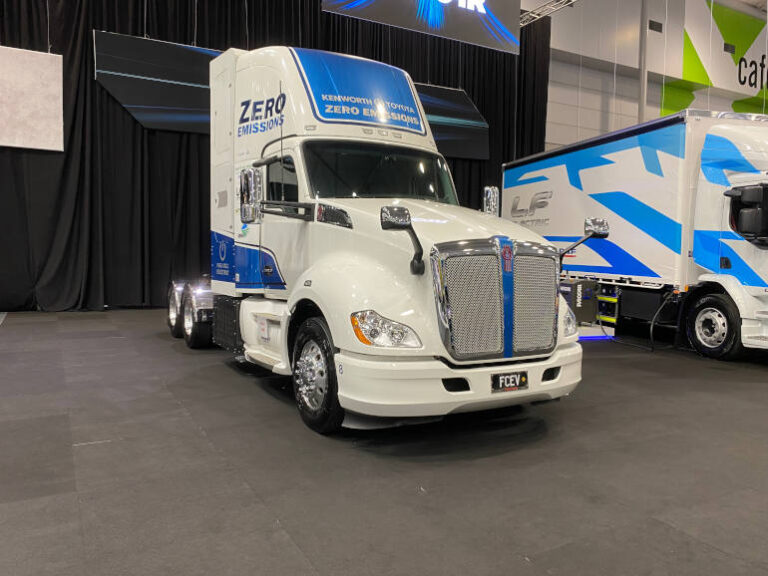
At the Australian Trucking Association’s Technology and Maintenance Conference (TMC) 2025, hydrogen was discussed not as a futuristic concept, but as a technology on the edge of practical deployment — provided Australia can align its technical standards, workforce training, and regulatory frameworks.
Nathan Pearce-Boltec, Technical Solutions Engineer at BOC South Pacific, told delegates that while hydrogen is already powering vehicles overseas, Australia must first address a range of engineering, safety, and compliance challenges before it can scale to support the transport industry.
“Hydrogen is a zero-emission fuel and we can combust it safely in a conventional engine or use it in a fuel cell,” Pearce-Boltec said. “The technology exists — what’s missing is a clear set of local standards and the technical guidance that makes it easier for project developers, regulators, and operators to work together.”
Standards and compliance still evolving
Hydrogen fuel systems operate at extremely high pressures — up to700 bar for gas storage or minus 253°C for liquid hydrogen — and that brings new safety and certification considerations. Pearce-Boltec said that Australia’s current regulatory framework is still catching up with these realities.
“One of the biggest challenges is that our hazardous area and explosive atmosphere standards are different to those used overseas,” he explained. “Almost every electrolyser or refuelling component imported into Australia has required reassessment or modification before approval. That adds cost and time to projects that are already complex.”
He added that approvals and compliance pathways are not yet well defined for hydrogen installations. “Developers are often unsure which codes apply, who the responsible authorities are, or what documentation is required,” he said. “We need clearer guidance — something that brings regulators, safety experts and engineers together early so projects aren’t delayed halfway through construction.”
Technical readiness and safe design
From a technical perspective, Pearce-Boltec said the fundamentals of hydrogen storage and refuelling are well understood thanks to decades of experience in industrial gas applications. However, when applied to heavy vehicles, it introduces unique integration and design challenges.
“To store enough energy for a long-haul truck, hydrogen must be either highly compressed or liquefied,” he explained. “That means heavier pressure vessels, thicker metals, and strict safety separation distances. These are manageable issues — but only if designs are standardised and approved under a consistent regulatory framework.”
He also highlighted the benefits of liquid hydrogen as a safer and more space-efficient option for transport fleets. “Instead of 700 bar of compressed gas, liquid hydrogen is stored at one bar pressure,” he said. “It reduces the risk of jet fires in the event of a rupture and simplifies refuelling system design — but it demands extremely low-temperature materials and rigorous engineering.”
Training and technical skills
As hydrogen systems move from laboratories to truck depots, the skills gap becomes increasingly important. Pearce-Boltec said there is confusion across the industry about which trades are qualified to work on hydrogen systems.
“We’ve seen cases where plumbers were asked to sign off on gas connections for fuel-cell vehicles,” he said. “Hydrogen equipment involves cryogenic systems, high-pressure piping and electrical interfaces — it’s not the same as installing a gas line in a building. We need a new skill framework that’s specific to hydrogen technology.”
He called for collaboration between training institutions, regulators, and industry bodies to ensure technicians, mechanics and emergency responders are equipped for the emerging fuel systems. “We need to train for what’s coming — not retrofit the skills later,” he said.
The role of social licence
Beyond technical standards, Pearce-Boltec said public confidence will play a critical role in the rollout of hydrogen refuelling infrastructure.
“If you asked people whether they’d accept a hydrogen station across the road from their child’s school, many would probably say no,” he said. “That tells us we’re not communicating well enough. Hydrogen can be handled just as safely as diesel or LPG — but we have to show people how those risks are controlled.”
He added that community engagement and transparency are essential for gaining approval and maintaining trust as hydrogen hubs are developed across Australia.
Building a framework for growth
Pearce-Boltec said hydrogen projects are often slowed not by the technology, but by the uncertainty around compliance and approvals. “In many cases, projects are delayed or redesigned midstream because safety distances or equipment classifications weren’t clarified early,” he said. “These changes can quickly turn a viable project into an unviable one.”
He urged governments and industry regulators to focus on building a nationally consistent hydrogen code that defines safety standards, component certification, and installation requirements.
“We’re still trying to fit square pegs into round holes,” he said. “We’re applying legacy gas standards to new hydrogen systems that behave differently. What we need is a harmonised approach — clear, science-based rules that give investors and operators certainty.”
A pathway to zero emissions
Despite the current challenges, Pearce-Boltec remains optimistic that hydrogen can play a key role in decarbonising Australia’s freight sector. “We already know hydrogen works — the question is how to make it scalable and compliant within our local context,” he said.
With federal and state governments now investing heavily in hydrogen hubs, electrolyser manufacturing and refuelling pilots, the foundations are being laid. But Pearce-Boltec said technical governance must evolve at the same pace.
“Hydrogen will only become a viable low-emission transport fuel when the technology, regulation, and workforce all align,” he concluded. “The engineering is ready — now it’s time for Australia’s standards and policy frameworks to catch up.”
- Parramatta found a simple way to tackle EV resistance
 Range anxiety isn’t always solved with another spreadsheet. Sometimes you need to hand someone the keys. That’s one of the lessons from City of Parramatta’s fleet electrification program, where an EV drive week has become an important tool for building employee support for the transition. Speaking at Everything Electric Sydney during a panel featuring finalists
 - Ausgrid’s charging strategy goes well beyond the depotInstalling chargers at the depot might be the obvious starting point for fleet electrification. For Ausgrid, it wasn’t going to be enough. As the electricity network continues electrifying passenger vehicles, vans and trucks, it has developed a charging strategy designed around how employees actually use fleet vehicles. Speaking during the Fleet News Group Awards finalists
- For Allianz, EVs are now business as usualFor many organisations, fleet electrification still means pilots, trials and discussions about what might happen next. At Allianz, the conversation has moved on. After starting its transition with a small pilot of 12 vehicles two years ago, the insurer has reached the point where electric vehicles are becoming part of its normal fleet replacement process.
- A Charger That Powers Up Isn’t Finished: Why Commissioning Matters for Fleet EV ChargingAn EV charger can be installed, connected and apparently operating — and the charging system can still be wrong. That is one of the more important lessons from the Local Council EV Integration Project involving Wyndham, Brimbank and Moonee Valley councils. As fleet charging installations become larger, depots are adding not only chargers but load
- How to Install EV Charging Without Shutting Down the DepotBuying electric vehicles may be the visible part of fleet electrification, but much of the hard work can happen underground. Trenching, conduits, electrical upgrades, switchboards, charger foundations, communications, traffic management and electrical shutdowns all need to be completed while the depot continues doing its normal job. Experience from the Local Council EV Integration Project involving