


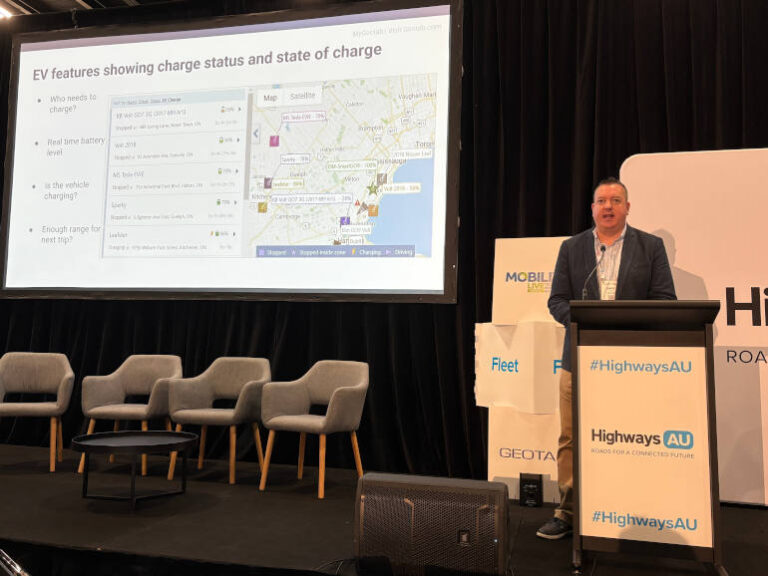
At Mobility Live 2025 in Sydney, David Brown, Associate Vice President of Sales – APAC at Geotab, shared how fleets can make practical, data-driven decisions when transitioning to battery electric vehicles (BEVs). Rather than framing electrification as a leap of faith, Brown positioned it as an opportunity that can be guided by insight, not guesswork.
“If I’m a Fleet Operator today, there are two ways to hit CO₂ emissions targets,” Brown explained. “I can start transitioning vehicles to electric, or I can make the most of the fleet I already have. Either way, the key is understanding my data and using it intelligently.”
With 5 million connected vehicles globally and more than 100 billion data points processed every day, Geotab has become one of the most comprehensive telematics platforms in the world. But Brown stressed that the value isn’t in the data volume — it’s in turning that data into actionable guidance for fleet managers who are planning their next steps.
Step 1: Identify the Right Vehicles to Electrify
The starting point, Brown said, is knowing which vehicles in a fleet are most suitable for electric replacement. Geotab’s Electric Vehicle Suitability Assessment (EVSA) is designed to do exactly that.
“If a device has been installed in a vehicle for at least three months, you’re already collecting data like kilometres travelled, trip durations, fuel economy, and idle time,” Brown explained. “We combine that with live data from electric models available in Australia — their range, charging behaviour, and performance profiles — and match them to your vehicles.”
Within minutes, the algorithm produces a report showing which internal-combustion vehicles can be replaced, and with which specific make and model of EV.
“A Fleet Manager could do this manually, but it would take months,” Brown said. “With telematics, it takes 15 to 20 minutes — and it’s based on your actual operating data, not assumptions.”
This approach removes much of the uncertainty surrounding EV investment decisions, providing a clear business case for when and where to electrify first.
Step 2: Manage the Transition Smoothly
Electrification doesn’t end at the purchase stage. Brown emphasised that once the new vehicles arrive, fleets need to actively manage charging, range, and battery health.
“The battery is the most expensive component of a BEV,” he said. “So keeping it in good condition is critical.”
Geotab’s platform monitors each vehicle’s state of charge, charging session data, and long-term battery health trends. It integrates with multiple charging-station providers, giving Fleet Managers visibility over when, where, and how vehicles are being charged — a vital step for controlling running costs and ensuring operational readiness.
This data can also highlight inefficiencies. For example, vehicles sitting idle with high charge levels may point to under-utilisation, while repeated deep discharges could flag early battery degradation. Over time, these insights help fleets build evidence-based charging policies that extend asset life and improve total cost of ownership.
Step 3: Optimise the Remaining ICE Fleet
For many organisations, full electrification won’t happen overnight. Brown said that fleets can still achieve meaningful emissions reductions using telematics across their existing vehicles.
“Maintenance is one of the hardest things to manage at scale,” he said. “By detecting fault codes automatically and scheduling repairs before breakdowns occur, fleets can reduce downtime and avoid unnecessary fuel use.”
Driver behaviour is another major opportunity. Telematics-based coaching and gamification programs can curb aggressive driving and idling — two of the largest contributors to unnecessary fuel burn and emissions.
“When safety and efficiency improve, CO₂ naturally comes down,” Brown said. “You’re saving fuel, reducing maintenance, and keeping vehicles on the road longer.”
Step 4: Use Benchmarking and Predictive Analytics
The next phase of fleet optimisation involves prediction rather than reaction. Geotab uses anonymised, aggregated data from its global network to allow fleets to benchmark performance against similar operations.
“Predictive analytics can identify drivers or vehicles at higher risk of incidents or inefficiency before it happens,” Brown explained. “It’s about taking proactive control of your operations rather than waiting for the report at the end of the month.”
This level of visibility not only supports safety programs but also strengthens the business case for further electrification. By comparing fuel use, maintenance, and downtime between EV and ICE vehicles, Fleet Managers can demonstrate tangible returns to senior leadership teams.
Step 5: Engage Drivers Through Feedback and Rewards
Transitioning to BEVs isn’t just a technical change — it’s a cultural one. To ensure drivers are engaged and motivated, Geotab’s new Vitality app allows them to track their own driving performance and earn rewards for safe and efficient habits.
“It’s about positive reinforcement,” Brown said. “If you hit your targets, you can earn vouchers for places like Bunnings or Coles. It’s a way to turn behavioural change into something tangible.”
Early pilot results from the US and Europe have been encouraging:
- 15% improvement in safe driving within one month
- 14% reduction in maintenance and repair costs
- 12% increase in fuel economy across mixed fleets
Turning Insight into Action
The takeaway from Brown’s keynote was clear — the transition to electric fleets is no longer just a technology conversation. It’s a data-driven operational transformation.
Fleet Managers now have tools that make EV adoption measurable, manageable, and financially justifiable. Whether a fleet is ready to make the full switch or still balancing ICE and BEV assets, telematics provides the roadmap for making decisions grounded in evidence.
“Electrification doesn’t have to be overwhelming,” Brown concluded. “When you use data to guide every step — from selecting the right vehicles to monitoring how they perform — you can move with confidence. That’s how fleets will reach their sustainability goals.”
For fleet operators, the message from Mobility Live 2025 is simple: don’t guess your way into electrification. Measure it, manage it, and make it work for your business — one data point at a time.