


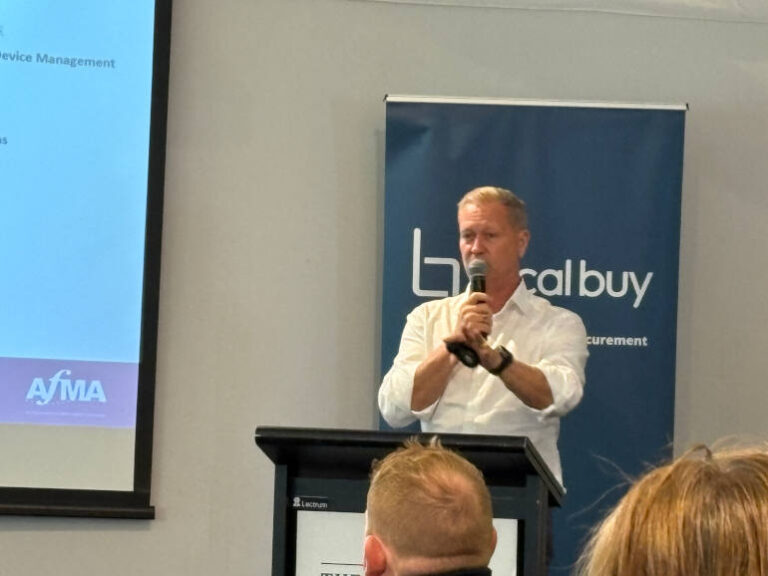
At the Local Buy SEQ Fleet Forum in August, Marc Hartley, Executive Director at AfMA, explored how the digitisation of vehicles and fleet management is reshaping operational strategies, delivering cost savings, and enabling better decision-making.
From Analogue to Digital Vehicles
Hartley introduced the idea of “analogue” versus “digital” vehicles.
- Analogue vehicles include internal combustion engine (ICE) models and traditional hybrids. They leave the dealership in their best condition and remain largely unchanged until disposal.
- Digital vehicles—battery electric vehicles (BEVs), hydrogen-powered vehicles, and advanced plug-in hybrids—are different. They receive over-the-air updates, often becoming more capable over time without hardware changes.
For example, Hartley described how his own BYD had improved through software updates, gaining features like wireless Apple CarPlay and enhanced safety functions such as improved autonomous emergency braking in low light. This capability challenges traditional replacement cycles: fleets may be able to extend vehicle life while maintaining (or even improving) capability.
Data Intelligence Beyond Telematics
Hartley emphasised that data intelligence is more than just tracking vehicles. While many fleets first implement telematics to locate assets and reduce speeding, the possibilities are far broader.
He cited examples of integrating IoT devices into fleet assets—such as air quality sensors on New York government vehicles—to gather environmental data while vehicles go about their daily tasks.
The key is interoperability. Some systems are closed, allowing only proprietary devices, while others are open and can integrate any compatible sensor or camera, including driver-facing cameras for fatigue detection.
Automation of Processes
Digitisation also enables automation that cuts administration and improves accuracy. Hartley referenced solutions where telematics data integrates directly with service delivery and billing systems—removing manual processes like odometer recording and client trip forms.
Benefits include:
- Faster, more accurate invoicing
- Reduced administrative burden
- Freed-up staff time for higher-value work
Case Study: Essential Energy
Hartley highlighted Essential Energy, which operates nearly 2,000 vehicles covering 34 million kilometres annually. By integrating telematics with internal systems and geographic hazard mapping, they achieved:
- 20% reduction in operational cost per kilometre
- 94% completion of pre-trip inspections
- Reduction in accident rates per 100 vehicles to 5%
Their three-tier system—fleet management software, a driver interface, and telematics—demonstrates how integrated digital solutions can deliver tangible safety and cost benefits.
The Next Step for Fleets
For Hartley, the message was clear: digitisation is not just about adopting new technology—it’s about rethinking replacement cycles, using data for strategic decision-making, and automating processes to increase efficiency. As vehicles become more capable over time and systems become more connected, the potential for cost savings, safety improvements, and sustainability gains grows significantly.