

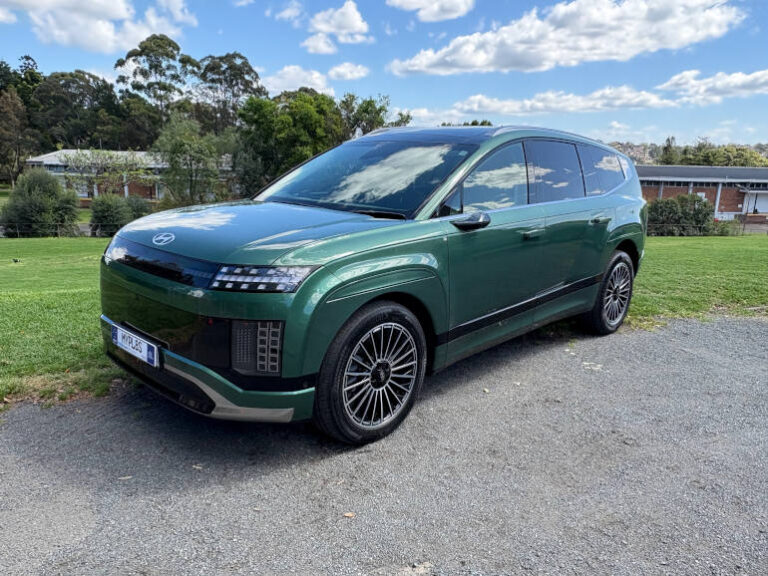
The Hyundai IONIQ 9 isn’t just another electric SUV. This is Hyundai stepping boldly into the luxury space, showing it can go toe-to-toe with prestige brands while still bringing that clever, thoughtful Korean engineering we’ve come to expect. And with an on-the-road price hovering around $135,000, this isn’t an everyday commuter special. This is a flagship family car with a proper luxury badge feel.
Who’s Buying the IONIQ 9?
The buyer of this car is not fussed about pinching pennies. If you’re cross-shopping this, you’re probably also considering a Genesis GV80, a BMW iX, or maybe even a fully optioned Kia EV9. You’re not looking for the cheapest way to move seven people around. You want:
- Luxury without compromise.
- Tech that feels futuristic.
- Space for family, friends, or colleagues without sacrificing comfort.
- And, let’s be honest, a vehicle that turns heads in the driveway.
If you have three kids, you could buy a Kia Carnival and get the most practical family car on the planet. But that’s not what this buyer wants. This buyer wants the ego and elegance of a big SUV, not a people mover — and that’s exactly what the IONIQ 9 delivers.
First Impressions – Big but Graceful
On paper, it’s a huge machine: over five metres long and nearly two metres wide. But Hyundai’s design team has worked wonders. Compared to the boxy Kia EV9, the IONIQ 9’s sleeker lines, sloping bonnet, and refined detailing make it feel less intimidating.
Behind the wheel, that translates into confidence. Yes, you’re piloting a 2.6-tonne beast, but the steering is light, visibility is good, and it doesn’t feel clumsy or unwieldy.
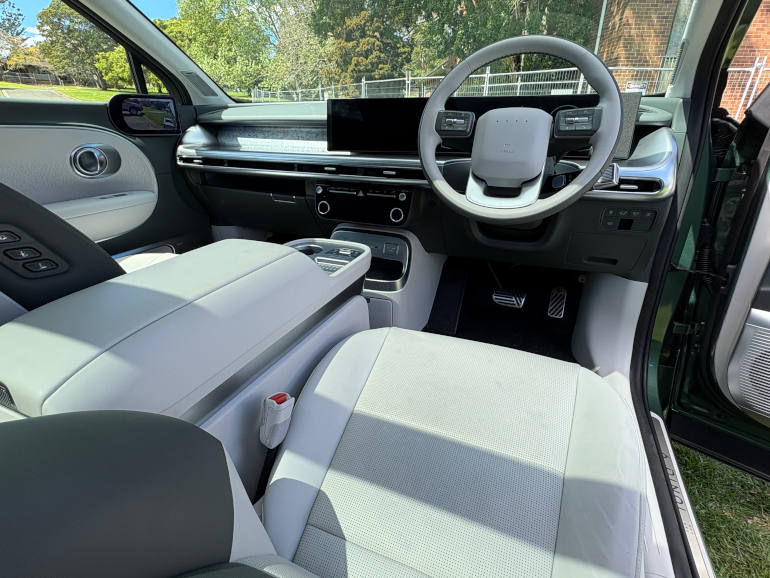
Inside, first impressions scream “luxury.” The Calligraphy trim serves up plush nappa leather, suede headlining, and clever mood lighting. But Hyundai hasn’t forgotten usability – proper air-con buttons, a traditional gear stalk, and easy-to-reach cupholders prove this was designed by people who drive, not just stylists with sharp pencils.
Rear Seat Royalty
The rear cabin is where the IONIQ 9 really shines. Too many SUVs make the second row an afterthought, but Hyundai’s designers clearly knew that in a car this size, those seats matter. Slide into the back and it feels like you’re on a plush sofa. The legroom is generous, the recline is just right, and you could easily imagine being chauffeured around in it.
Add in little luxuries like:
- A centre console that opens from front and back (so rear passengers can help themselves to wipes or tissues).
- USB-C ports everywhere you look.
- A proper BOSE premium sound system with active road noise cancellation.
This is an SUV where everyone feels like a VIP passenger.
Quirky Tech – Digital Mirrors & Phone Sanitisers
The IONIQ 9 is as much about tech theatre as it is about torque. Hyundai has rolled out:
- Digital side mirrors and a digital rear-view mirror – giving clearer, obstruction-free views. It takes a few days to adjust (the resolution can make cars feel closer than they are), but once you adapt, it’s brilliant.
- A UV-C phone sanitiser slot – pop your phone in, zap the germs, and pretend you’re living in 2020 with a COVID lockdown.
- Clever hidden storage shelves so your dash doesn’t look like a dumping ground.
It’s playful, it’s futuristic, and it all works surprisingly well.
Battery, Range & Charging Confidence
This is where the IONIQ 9 really impresses. Hyundai has taken the EV anxiety out of the equation:
- Battery: 110.3 kWh lithium-ion.
- Range: Easily over 500 km in real driving. The clever dash display gives a minimum and maximum range estimate – anywhere from 303 km to 645 km – so you know exactly what to expect, depending on how you drive.
- Charging:
- Ultra-fast 350 kW charger: 10–80% in just 24 minutes.
- 50 kW DC charger: 10–80% in about 109 minutes.
- Home wallbox (10.5 kW): Full charge in roughly 10 hours.
That flexibility makes it a true long-distance luxury cruiser. You can road trip with confidence, knowing you’ll cover serious ground between stops.
Practical Touches in a Luxury World
Yes, it’s luxurious. But Hyundai hasn’t forgotten practicality:
- Towing capacity: 2,500 kg braked – big enough for a caravan or boat.
- Cargo space: 338L with all three rows up, or 908L with the third row folded.
- Third row: Roomy enough for kids or short trips, and folds flat at the touch of a button.
It’s still a family car at heart, even if it wears a luxury suit.
Verdict – The Luxury EV Hyundai Needed
The Hyundai IONIQ 9 proves that the brand can do luxury every bit as well as the Europeans – but with its own clever twist. It’s stylish, spacious, and full of thoughtful tech.
At $135,000, this isn’t a car you’ll see on every street corner. It’s not a novated lease hero – it’s a statement piece for those who want a flagship family SUV with genuine cachet.
And here’s the thing: you won’t just be buying a car. You’ll be buying the luxury EV experience – lounge-like comfort, futuristic tech, and the confidence that comes with 600 km of electric range.
Hyundai wanted the IONIQ 9 to be aspirational. Mission accomplished.
Sidebar: Digital Mirrors – Friend or Foe?
One of the big talking points in the IONIQ 9 is its use of digital side and rear-view mirrors. Instead of old-school glass, you get full-screen displays inside the cabin. The experience is a mixed bag at first: the digital rear-view mirror gives a wonderfully clear, obstruction-free view – no more squinting past kids’ heads or luggage stacked to the roof – and the wider field of vision means blind spots are almost eliminated. But the adjustment period is real. At night, the glare can feel distracting, and during the day the resolution sometimes makes it look like cars are right on your bumper, which takes getting used to. The good news is, after a few days, most drivers report it starts to feel normal, and the benefits of visibility outweigh the quirks
- Origin partners with EVDealer Group to accelerate fleet transition
 Origin and EVDealer Group have partnered to give Australian businesses a single, end-to-end path to electric vehicles (EVs) – from planning and charging through to vehicle delivery and driver handover – so fleet managers no longer have to coordinate it all themselves. Origin’s Group Manager Sales, E-mobility, David Helmy, said, “Businesses tell us the hardest
 - Volkswagen ID. Buzz Cargo wins 2026 Fleet EV of the YearThe Volkswagen ID. Buzz Cargo has been named the 2026 Fleet EV of the Year in the Fleet News Group Awards, finishing ahead of two very different electric fleet propositions after assessment by fleet industry judges using Best Value Analysis. The Volkswagen ID. Buzz Cargo BEV 550 competed against the Toyota HiLux SR BEV 4×4 Double Cab Pickup and Kia EV5 Air
- Kia PV5 wins 2026 Fleet LCV of the YearThe Kia PV5 Cargo has been named the 2026 Fleet LCV of the Year in the Fleet News Group Awards, giving Kia an important win as electric commercial vehicles move further into mainstream fleet consideration. The Kia PV5 Cargo S 4D LR finished ahead of the Hyundai STARIA Load Hybrid and Isuzu D-MAX SX 2WD Single Cab, giving judges three very different
- Toyota Camry wins 2026 Fleet Car of the YearThe Toyota Camry Ascent Sport has been named the 2026 Fleet Car of the Year in the Fleet News Group Awards, reinforcing the continuing role hybrid vehicles can play in helping fleets reduce fuel use and emissions. The Camry finished ahead of the MG ZS Vibe CVT and Subaru Forester Hybrid AWD after assessment by fleet industry judges and Fleet News
- Can an electric van really be better to drive all day? Kia thinks soFor Fleet Managers considering electric vans, range, payload and charging usually dominate the discussion. But there is another factor that can have just as much influence on whether a new vehicle succeeds in a fleet: what drivers think of it after spending an entire working day behind the wheel. That was one of Kia’s priorities