


Ventura Bus Lines is approaching its passenger vehicle transition the same way it manages buses: by matching the vehicle to the job it needs to do.
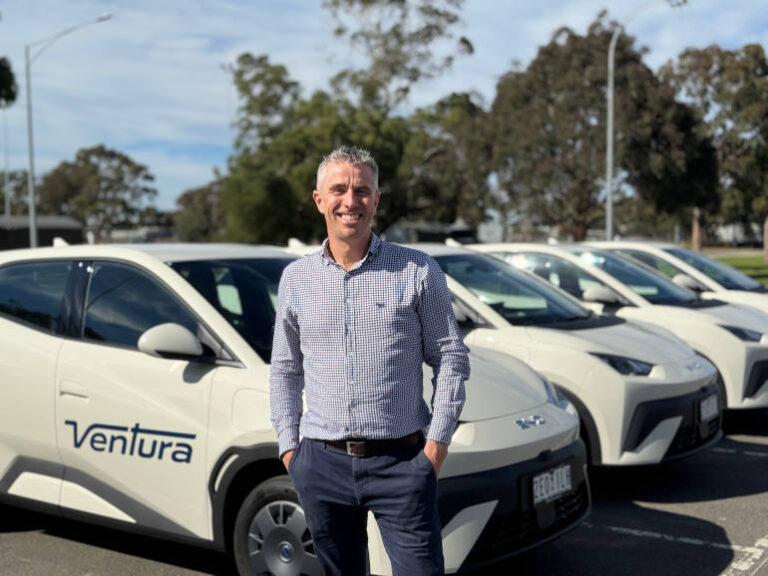
The company has already introduced five BYD electric passenger vehicles into its light fleet, using them as driver changeover cars across its bus operations. For Jeremy Gunnell, Executive General Manager – Assets at Ventura Bus Lines, the move is part of a broader emissions reduction strategy, but it also had to make operational and financial sense.
“Traditionally, in that space, we ran over time some Toyotas, and we’ve had Suzukis, but for the last five or so years, we’ve been running the Kia Picanto,” Gunnell said.
The decision to move to electric vehicles was influenced by Ventura’s environmental, social and governance commitments, as well as the company’s existing relationship with BYD through its electric bus fleet.
“We obviously got some governance around our ESG policy and what we can do to try and reduce our carbon footprint and emissions in which we produce as a result of our service we offer,” Gunnell said. “We just thought it was a nice, clean way of aiding that process.”
Starting with the right use case
The first BYD electric cars are being used as driver changeover vehicles. These cars support route bus operations by taking drivers to interchange points so another driver can continue the service while the first driver takes a break.
“We’ve specifically brought those vehicles for what we call a driver change over car,” Gunnell said. “When we have the buses out on route, a lot of the time, the shift or the route in which the bus has to run doesn’t support the driver having the opportunity have their half an hour or one hour lunch break.”
The changeover vehicle allows the bus to stay in service.
“These cars will scoot out to an interchange point, and they stop at that interchange point, wait for the bus to arrive in a timely manner, and then they swap drivers,” Gunnell said. “The bus continues on so there’s no disruption to the service or the passengers on that service.”
It is a good example of how fleets can begin electrification with a predictable, depot-based task rather than trying to convert every passenger vehicle at once.
Early fuel savings are measurable
Ventura is already tracking the benefits of the first five electric passenger vehicles. Gunnell said the early fuel saving was noticeable.
“In the first month, which was the month of April that we measured, across five vehicles, saved 800 litres of fuel consumption by having the electric vehicle,” he said.
While five vehicles is a small part of Ventura’s total light fleet, the result provides a measurable basis for future replacement decisions.
“When you consider, I think we’ve got around about 40 of those vehicles in our fleet,” Gunnell said. “At the moment, we’ve only got five electric cars. But in our budget, which new budgeted period, which kicks off in FY27 in a couple of months time, we’re planning to replace another half a dozen.”
Ventura plans to continue that staged replacement over coming years.
“We’ll continue to those that sort of run rate over the next couple of years, until such time where they’re all electric,” Gunnell said.
Procurement still needs to be practical
The BYD passenger vehicles were selected for a mix of cost, existing supplier relationship, size and safety.
“Their price point, for one, is very sharp,” Gunnell said. “Secondly, we already had a corporate relationship with BYD post the purchases of our heavy vehicles, so that really helped with the relationship and ability to get vehicles at a good price point.”
Gunnell said the cars also needed to be fit for their operational role.
“They’re a nice, nimble little car,” he said. “They’re much the same size as the Kia, which is convenient, and I’m not six foot tall, I fit in there quite comfortably. I’ve got good leg room. They’re comfortable, good, five star ANCAP safety rating.”
Charging is part of the operating model
Ventura has installed charging infrastructure at depots where the electric passenger vehicles operate, even where the bus fleet at that depot is still diesel-powered.
“We have implemented infrastructure so that they can be charged,” Gunnell said. “We’ve set up proper either charging bays and painted those or demarcated those in such a way that you can see the nice, clear delineation.”
The business has also adopted a simple operating rule: when a vehicle returns to the depot, it is plugged in.
“We’ve installed a one to one ratio, so one charger per car,” Gunnell said. “We’ve sort of created a bit of a policy in which if the vehicle is back at a depot, it’s plugged in. That way it’s always got the best state of charge for its next trip.”
Not every vehicle is ready for full EV
Ventura is not applying a one-size-fits-all powertrain strategy. While driver changeover vehicles are moving towards full electric, some supervisor and depot manager vehicles are being replaced with Toyota Camry Hybrids.
“The reason we’ve gone hybrid on those particular ones is because people driving them don’t necessarily have the charging infrastructure where they need it,” Gunnell said.
For Gunnell, hybrid vehicles provide a practical emissions reduction step where charging access is less predictable.
“The hybrid basically calls about 50% of your fuel consumption out, but still they have the ability to travel around without being stressed about range anxiety with an electric car,” he said.
For Fleet Managers, the lesson is clear. Electric passenger vehicles can deliver real savings when the use case is right, but the transition should be staged around operational needs, charging access and whole-of-life value. Ventura’s approach shows that emissions reduction starts with understanding the job each vehicle performs.