

Hino Australia is seeing stronger interest in hybrid trucks as fleet operators look for lower-emissions options that do not require the same compromises in cost, payload or infrastructure as some zero-emissions alternatives.
At Hino’s recent business briefing, President and CEO Richard Emery said the market had shown early enthusiasm for fully electric trucks, but broader uptake had not yet followed across all applications.
“We saw a surge in customers talking to us about full electric for a period of time during 2022 and 2023, but that seemed to slip away,” Emery said.
“I think you’ve seen that in the registration data from last year and into the start of this year. There really hasn’t been a significant growth or step in take-up of electric at this point in time.”
Practical constraints remain
Emery said the uneven uptake reflected the operational realities facing truck fleets.
“That’s because of the compromise in terms of many factors, including cost and payload,” he said. “It’s not quite practical. It hasn’t quite got the right balance yet.”
For Fleet Managers, that balance will vary by task. Battery-electric trucks can suit predictable metropolitan operations with manageable daily kilometres, access to depot charging and enough time for charging between shifts.
However, longer routes, higher payloads, limited charging access and irregular operating patterns can make the transition more difficult. In those applications, the replacement decision is not simply about emissions. It also involves route planning, vehicle utilisation, body weight, charging capacity, maintenance support and whole-of-life cost.
Hybrid interest is building
While full-electric demand has been uneven, Emery said Hino’s hybrid models had seen steadier market interest.
“We have seen a steady increase in interest in our hybrid electric product,” he said. “We’ve seen a solid month-on-month increase in interest in our hybrid electric product.”
Emery said Hino’s Hybrid Electric range had grown by 24 per cent in 2025 compared with the previous year, although he said there was still room for the technology to gain broader acceptance.
“It’s still a work in progress that we’ll continue to forge forward with,” he said. “It’s now a very regular conversation with our customers about the adoption or taking on hybrid electrics into their fleet.”
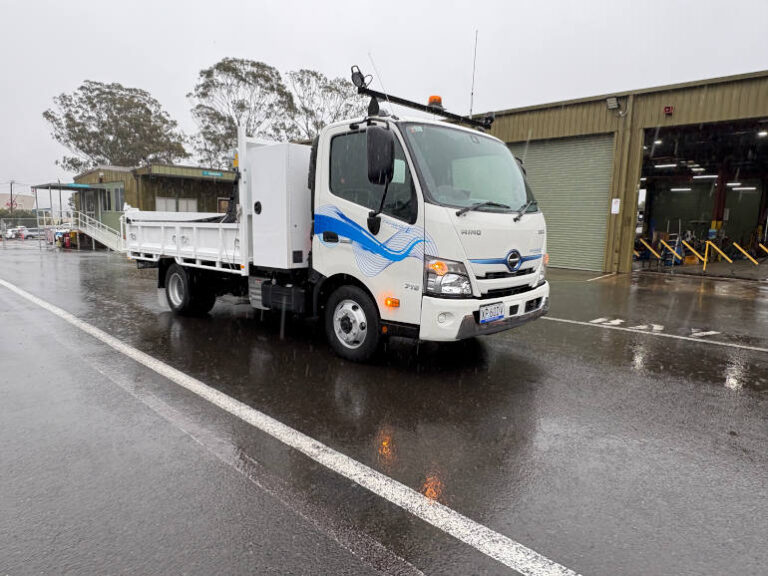
Hino said its 300 Series Hybrid Electric trucks can reduce fuel costs by up to 24 per cent in Wide Cab variants and 22 per cent in Standard Cab models compared with equivalent diesel trucks. Those figures are Hino claims and will depend on the work cycle, driving conditions and vehicle configuration.
A bridge rather than a compromise
The relevance of hybrid trucks is that they can reduce fuel use and emissions without requiring charging infrastructure or forcing the fleet to change how every vehicle operates.
This makes hybrid technology relevant to fleets that want to lower operating costs and emissions now, while they continue to assess where battery-electric or hydrogen vehicles can work in the future.
Hybrid systems are particularly suited to urban and stop-start operations, where regenerative braking and electric assistance can provide a stronger benefit.
Hino is planning to extend the approach with a 300 Series Hybrid Electric tipper, which Emery said would be well suited to the nature of tipper work.
“We see this as a key application that we can take advantage of hybrid electric technology,” he said.
“That stop-start nature of the work that tippers do, we believe lends itself very well to hybrid electric.”
The transition will be application-led
Emery’s comments reinforce the view that heavy vehicle decarbonisation is unlikely to follow one technology pathway.
Battery-electric trucks may be the right fit for some urban and depot-based applications. Hydrogen may emerge in other higher-utilisation or longer-distance tasks. Newer Euro 6 diesel vehicles will continue to play a role as older trucks are replaced. Hybrid trucks may provide a workable middle step for fleets that need measurable fuel savings and lower emissions without waiting for a complete infrastructure solution.
For Fleet Managers, the question is less about choosing one technology for the entire fleet and more about matching each technology to its operating task.
Hino’s experience suggests hybrid trucks are becoming part of that transition plan, particularly for fleets that want to act now but cannot yet make a full move to zero-emissions vehicles.