


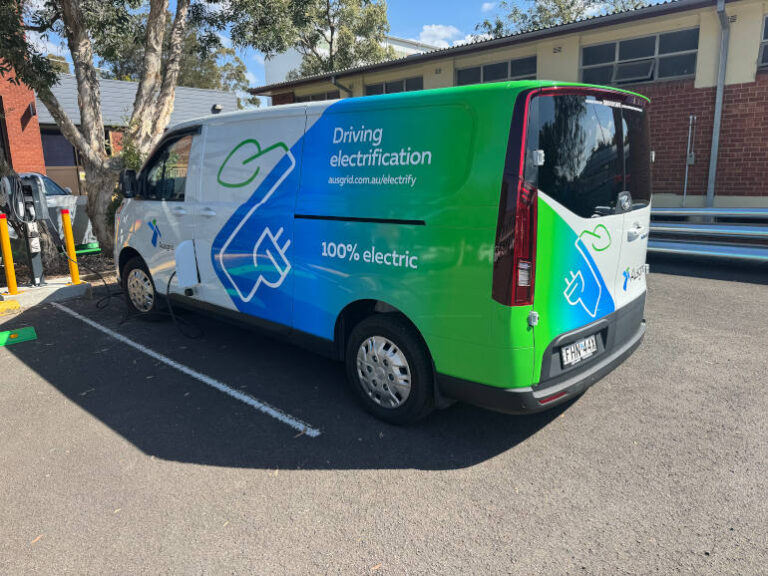
Installing chargers at the depot might be the obvious starting point for fleet electrification. For Ausgrid, it wasn’t going to be enough.
As the electricity network continues electrifying passenger vehicles, vans and trucks, it has developed a charging strategy designed around how employees actually use fleet vehicles.
Speaking during the Fleet News Group Awards finalists panel at Everything Electric Sydney, Ausgrid’s Nick Black outlined an approach covering depots, offices, substations, employees’ homes and the public charging network.
Ausgrid is a finalist in the Fleet News Group Awards program, and its experience provides a useful example for Fleet Managers moving beyond the first stage of electrification.

Start with vehicle movements
Ausgrid’s challenge was that not every employee starts and finishes their working day at the same location.
Some field staff travel from a depot to a worksite. Others travel between depots and offices, while some employees take fleet vehicles home.
That made simply installing chargers at central locations insufficient for the longer-term transition.
“We had to pull it back to looking at the way our field staff use the vehicles,” Black said.
The initial rollout targeted the easier opportunities.
“We started off by covering the lower hanging fruit, which is to put charging into the depots and into our office spaces,” he said.
But electrifying more complex operational vehicles required another step.
Portable DC charging at substations
Ausgrid is now examining portable 40kW DC chargers that can plug in at substations.
Black said permanent charging at every location isn’t necessarily desirable because Ausgrid doesn’t want some substations becoming long-dwell locations for employees. Portable charging provides another option.
“We’re looking at portable 40 kilowatt DC chargers that we plug in at our substations,” he said.
The technology can also provide vehicle-to-vehicle charging, giving operational vehicles another way to top up while working.
Solving home charging
Home charging presents a different fleet-management challenge: reimbursement.
Ausgrid is examining how telematics and vehicle data could be used to automate the process.
“We’re looking at how we could leverage our data from our telematics, as well as the vehicles, to automatically reimburse employees if they charge at home,” Black said. “We have a very data-driven approach to what we’re trying to solve here.”
Public charging forms another layer, with employees able to access external charging while travelling.
Charging needs to follow the operation
Ausgrid’s experience demonstrates why charging strategy becomes more complicated as organisations move beyond passenger vehicles based at predictable locations.
The network has already electrified its passenger fleet, purchased 47 electric vans and introduced electric trucks, while also trialling prime movers.
As the applications become more demanding, the charging network needs to evolve with them.
For Fleet Managers, that suggests a different starting question.
Instead of asking where chargers can be installed, first understand where the vehicles go, how long they stop and where they spend the night.
Then build the charging strategy around the fleet.