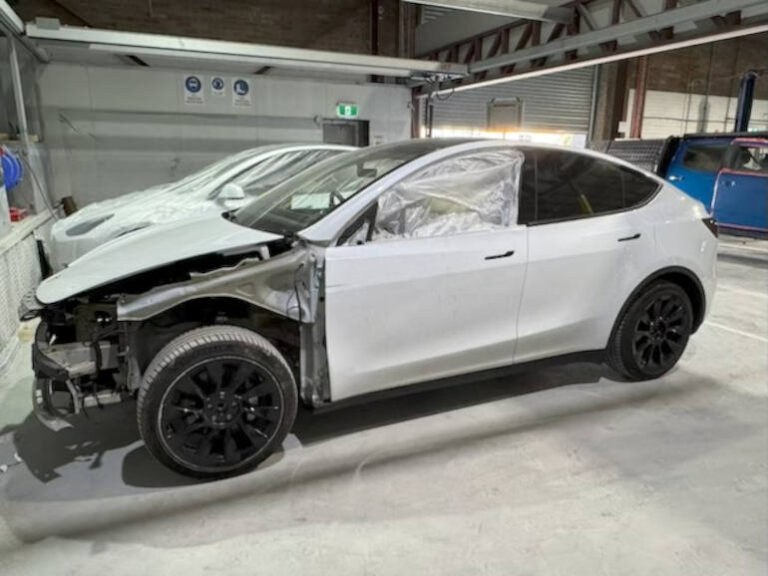
Electric vehicles are not only changing the way fleets power their vehicles – they are also reshaping the panel repair industry. New safety requirements, longer repair times, and higher costs mean Fleet Managers need to think differently about accident management as EV adoption grows.
Safety is non-negotiable
According to Shaun Janks, Co-Founder and Chief DingGo at DingGo, the biggest change is safety.
“If you put your hand in the wrong place before you’ve powered down the battery, you’re dead,” Mr Janks said. “Repairers have to learn the process of making an EV safe before pulling panels or removing linings. It’s life or death.”
To manage the risk, many repairers have created EV-only bays and trained specific staff to handle high-voltage vehicles. “The first bit of training everyone went through was safety – knowing how to power down the car before anything else,” he explained.
Repairs take longer
Even when damage is only cosmetic, the repair process takes more time with EVs.
“It’s about 20 per cent longer to repair an EV,” Mr Janks said. “That extra time comes from powering down, recalibrating ADAS systems afterwards, and even things like lifting the car onto hoists because of the extra battery weight.”
For Fleet Managers, that means factoring longer downtime into replacement planning and service level agreements with repairers.
Higher repair costs
The added labour translates into higher costs. DingGo’s data shows EV repairs are around 20 per cent more expensive on average than ICE vehicles.
“EVs are usually involved in less severe accidents, more cosmetic in nature,” Mr Janks said. “But even then, the average cost is higher. I’d hate to think what happens when an EV is involved in a major accident – the costs would be significantly higher than a comparable ICE vehicle.”
Parts supply challenges
While established brands like Toyota have well-developed parts networks, many EV brands are still building their supply chains in Australia. That creates extra delays.
“Some of the new OEMs are dumping cars into the market faster than they’re building aftermarket support,” Mr Janks said. “Panel shops struggle to get certain parts, particularly battery housings and structural components. Even simple things like pillars can be hard to source.”
For Fleet Managers, this means asking OEMs about local parts supply and factoring in the risk of longer vehicle downtime.
Common damage types remain the same
Although the repair process differs, the types of accidents are familiar. DingGo’s data shows front-end damage accounts for 26 per cent of incidents, doors for 17 per cent, and rear-end hits 13 per cent.
“Most repairs are still the usual bumpers, headlights and panels,” Mr Janks said. “It’s just that when it’s an EV, the safety and repair process around it is very different.”
Safer vehicles, but pricier repairs
The positive news is that EVs appear to be safer on the road. “We’re seeing a 19 per cent lower incident rate for EVs compared with ICE vehicles,” Mr Janks said. “They also tend to be involved in lower-severity accidents. The ADAS technology built into EVs is clearly playing a role.”
That means fleets may see fewer repairs overall, but when they do happen, they are likely to cost more and take longer.
What Fleet Managers should do
Mr Janks advised Fleet Managers to look beyond the purchase price when planning EV adoption.
“Fleets need to think about the support behind the vehicle – who can repair it, how quickly parts can be sourced, and how safe the repair process is,” he said.
For Fleet Managers, the key steps are:
- Check repairer capability – ensure your network is EV-certified.
- Plan for longer downtime – EVs take more time to repair.
- Factor in higher costs – include repair costs in whole-of-life models.
- Reduce accidents – invest in driver training, ADAS awareness, and telematics.
The shift to EVs is unavoidable, but with the right preparation, fleets can manage the risks. As Mr Janks summed up: “EVs are safer and involved in fewer accidents, but when they are damaged, repairs take longer and cost more. Fleet Managers need to plan for that balance.”
- Ford Strengthens Its Electric Van Line-Up
 Ford Australia is strengthening the fleet proposition for its electrified Transit Custom range, adding Pro Power Onboard as standard while repositioning the models within its expanding electric commercial vehicle line-up. Transit Custom PHEV and E-Transit Custom vehicles arriving in the second quarter of 2027 will feature a 2.3kW Pro Power Onboard system as standard, giving
 - Origin partners with EVDealer Group to accelerate fleet transitionOrigin and EVDealer Group have partnered to give Australian businesses a single, end-to-end path to electric vehicles (EVs) – from planning and charging through to vehicle delivery and driver handover – so fleet managers no longer have to coordinate it all themselves. Origin’s Group Manager Sales, E-mobility, David Helmy, said, “Businesses tell us the hardest
- Hyundai says it needs to tell its EV story againHyundai Australia believes it already has one of the broadest electric vehicle ranges in the market, but says it hasn’t done enough recently to make sure Australian buyers know about it. Speaking with Fleet News Group at Everything Electric Sydney, Hyundai Motor Company Australia Chief Operating Officer Gavin Donaldson said the brand needs to do
- SANY electric trucks hit the road with Prancer in NSWPrancer Australia has entered the electric truck market with SANY, taking on sales of the manufacturer’s light trucks and prime movers across New South Wales and Canberra. Speaking with Fleet News Group at Everything Electric in Sydney, Brenton Sweeney, Sales Executive Commercial Vehicles and Equipment at Prancer Australia, said the business had only recently taken
- MG backs powertrain choice as Australian EV market growsMG Motor Australia says the rapid growth in electric vehicle sales doesn’t mean every Australian buyer — or every fleet — is ready to make the same transition at the same time. Speaking at Everything Electric in Sydney, MG Motor Australia Marketing Director Dimitri Andreatidis outlined a multi-powertrain strategy that will see the company continue