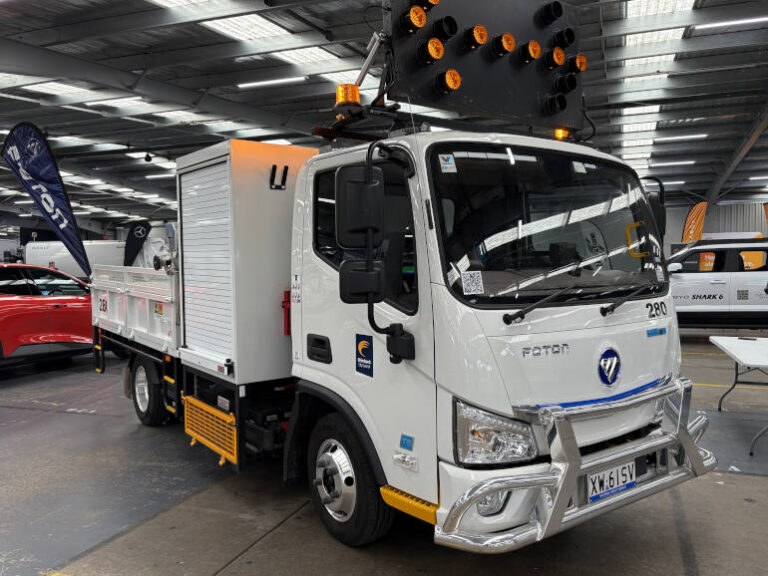
At the Fleet EV Expo for Local Government last month in Melbourne, one message rang loud and clear: councils cannot meet their Net Zero commitments without rapidly transforming their fleets. With electricity and buildings already well on the decarbonisation pathway, fleet has now emerged as the next major obstacle—and the panel session on Climate Change Targets and Transition to Net-Zero Fleet highlighted exactly why.
Featuring Paul Brown (Ironbark Sustainability), Yonis Dawd (Brimbank City Council) and Catherine Singh (City of Port Phillip), the discussion captured the big picture: councils have ambitious sustainability targets, but the EV transition is where those ambitions collide with operational reality.
Fleet Is Now the Largest Source of Council Emissions
More than 75% of Victorian councils have already shifted their corporate electricity to renewable energy sources. That transformation has dramatically reshaped emissions profiles: electricity now contributes close to zero.
The immediate consequence?
- Fleet has ballooned to around 40% of a council’s remaining emissions footprint.
Every kilometre matters now. Every policy choice matters. Every replacement cycle matters.
For councils with Net Zero targets in 2030, 2035 or earlier, fleet emissions hold the key to success—or failure.
Targets Are Set, But Technology and Asset Cycles Aren’t Keeping Up
Many councils committed to Net Zero years ago, long before the operational fleet market was ready for electrification. As Catherine Singh noted, the biggest opportunities for emissions reduction are now in the heavy and commercial fleet, but those assets simply don’t have mature zero-emission alternatives yet.
Street sweepers, waste compactors, and heavy trucks remain the hardest segment to decarbonise. Councils like Port Phillip are now exploring hydrogen for these classes, bypassing EVs entirely due to limitations in range, power and towing capacity.
Even where EVs exist, ten-year asset lives create structural barriers. Any diesel truck bought today will still be operating well beyond target dates.
The panel made it clear:
- You can’t hit a 2030 Net Zero target if you keep buying fossil-fuel vehicles in 2026.
- You can’t electrify the heavy fleet until the market catches up.
This tension between ambition and practical constraints is shaping every conversation inside councils.
Infrastructure and Power Are Becoming Critical Bottlenecks
Electrification requires more than just vehicles. It demands:
- upgraded depots
- new power supply
- load management
- back-of-house charging
- long-term capital planning
For Brimbank City Council, power supply constraints and infrastructure cost remain major barriers. Even if vehicles are available, connecting them into the grid is not straightforward. Councils must now make decisions about how much they are willing to spend—and how quickly.
Curbside Charging Will Become a Core Council Responsibility
One of the more forward-looking insights came from Paul Brown, who highlighted that councils will soon take on a new role: parking management for curbside charging.
As residential EV adoption rises, councils will be forced into managing kerb allocations, access rules and community expectations—even if they don’t install or operate chargers themselves. EV transition, therefore, isn’t just a fleet issue. It’s a city-shaping issue.
Scope 3 Emissions: The Next Wave of Sustainability Reporting
While fleet now represents up to 40% of corporate emissions, the panel emphasised that Scope 3 emissions are even larger—and councils are currently reporting only a fraction of them.
New federal requirements for large organisations will flow through to councils, meaning they will need to account for:
- embodied emissions in vehicles
- emissions from contractors and suppliers
- emissions from construction and infrastructure services
This shift will place pressure on suppliers—everyone from road builders to vehicle OEMs—while strengthening the case for electric and zero-emission fleet procurement.
Internal Structures Are Slowing EV Progress
Beyond technology and infrastructure, the panel pointed to internal factors that significantly influence an EV transition:
- whether the fleet is leased or owned
- whether employees have vehicle choice
- the presence (or absence) of internal champions
- how fleet decisions are governed
- the weight of legacy salary-packaged arrangements
- budget pressures from elected councillors
These organisational structures often slow down EV adoption more than vehicle availability.
Net Zero Depends on Fleet Leadership
As councils close in on their target dates, the panel was unanimous: Fleet Managers will play a critical role in determining whether Net Zero is achievable.
Fleet sits at the intersection of:
- sustainability targets
- procurement strategy
- infrastructure investment
- asset management
- workforce policy
- community expectations
If fleet doesn’t transform, councils simply cannot meet their targets. The transition is “inexorable,” as Ironbark’s Paul Brown put it. It will happen. The only question is how fast, and whether councils have the structures, policies and investment pathways in place to drive it.
The Path Ahead
The EV transition is no longer a forward-looking aspiration—it’s now a core requirement for delivering on climate and sustainability commitments. For local governments, moving from strategy to action will require:
- aligning asset management plans with target dates
- prioritising the electrification of mission-critical fleets
- upgrading infrastructure
- reshaping internal fleet policy
- preparing for scope 3 requirements
- and navigating ongoing technology gaps
Fleet is now the pivot point for Net Zero. And councils that begin reshaping their fleets today will be the ones that meet their commitments tomorrow.
- EVs are turning employees’ homes into fleet fuel stations
 For decades, fleet fuel management has been relatively straightforward. Give the driver a fuel card, let them visit a service station and receive an invoice detailing the transaction. Electric vehicles are changing that model because the organisation can suddenly be responsible for procuring the energy used to power its fleet — and some of that
 - Foton and Ampol Target Electric Truck ChargingFoton Mobility Distribution (FMD) and Ampol have signed a Memorandum of Understanding to explore charging solutions for electric truck fleets, with a focus on helping operators charge at depots, commercial hubs and public charging sites. The collaboration will investigate charging options across Ampol’s AmpCharge public network and private facilities for FMD’s fleet, logistics and business
- Ausgrid’s charging strategy goes well beyond the depotInstalling chargers at the depot might be the obvious starting point for fleet electrification. For Ausgrid, it wasn’t going to be enough. As the electricity network continues electrifying passenger vehicles, vans and trucks, it has developed a charging strategy designed around how employees actually use fleet vehicles. Speaking during the Fleet News Group Awards finalists
- Home Charging Enters a New Growth PhaseEvnex has passed 20,000 connected charger installations across Australia and New Zealand, with rapid growth reflecting the shift of home EV charging from an early-adopter product to mainstream infrastructure. The Christchurch-based manufacturer shipped its first charger in 2017. While reaching the first 10,000 installations took eight years, the next 10,000 were added in just nine
- Ampol’s $225 million Evie deal puts a new value on public EV chargingAmpol’s proposed $225 million acquisition of Evie Networks could prove to be a significant milestone for Australia’s EV charging sector, putting a substantial transaction value on a public charging network that was built well before electric vehicles became a mainstream consideration for Australian fleets. Ampol Energy has entered into an agreement to acquire 100% of