


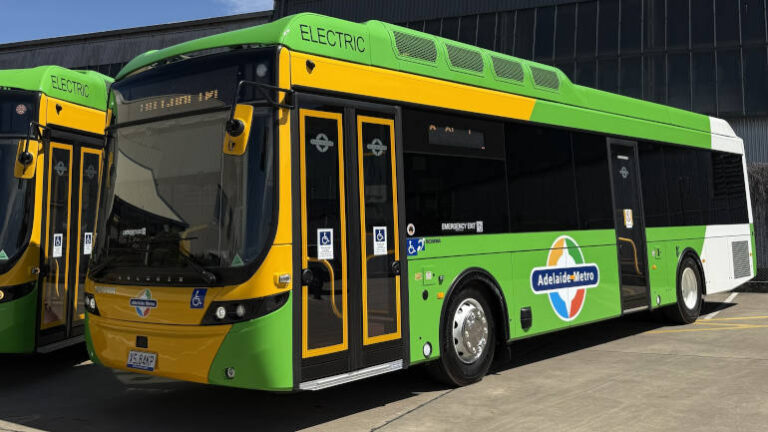
South Australia has taken another major step towards a fully decarbonised public transport network, with the first of 94 new-generation Scania electric buses now delivered and preparing to enter service. The milestone marks a significant acceleration in the State Government’s transition to zero-emission transport across Adelaide Metro’s bus and rail operations.
The new battery-electric buses form part of a broader program to replace ageing diesel vehicles, reduce emissions, and strengthen the sustainability of metropolitan transport services. With full rollout expected by mid-2026, the incoming fleet is set to offer quieter, cleaner and more technically advanced services for commuters across Adelaide.
Australian-Made Bodies, Zero Tailpipe Emissions
The first buses have been handed over to the Department for Infrastructure and Transport (DIT) after extensive collaboration between Scania Australia, local body builders, and government stakeholders.
Jamie Atkinson, National Sales & Contracts Manager for Scania Australia, described the delivery as an important moment for the state’s transport future.
“We are delighted to bring to the streets of South Australia the first of 94 fully electric latest generation Scania K-series route buses, fitted with Australian-made bodies.”
He highlighted that the technology will enhance both environmental performance and the passenger experience.
“When in service, fully electric buses are all but silent in operation 100% of the time, with no tailpipe emissions at all. When powered by electricity produced from renewable sources in South Australia, they deliver public transport that is cleaner and greener than ever.”
“This technology is a win for commuters and the environment.”
A Long-Term Commitment to Cleaner Transport
Atkinson noted that the transition to electric builds on a longstanding partnership between DIT and Scania in lowering public transport emissions.
“DIT and Scania have long been committed to driving the shift towards a sustainable transport solution for route buses in South Australia.”
“All diesel-powered buses supplied by Scania since 2015 have been compliant with Euro 6 emissions standards, almost a decade ahead of Australia introducing that standard.”
“For the past several years Scania has been supplying low emission Hybrid Electric powertrains to the South Australian Government for Adelaide Metro public transport, as well as the first fully battery electric bus, which entered in late 2023.”
Advanced Safety for Drivers and Road Users
Alongside emissions benefits, Scania is equipping the new electric fleet with its full suite of Advanced Driver Assistance Systems (ADAS). The technology strengthens route safety at a time when bus operators across Australia are prioritising both driver protection and vulnerable road user safety.
“Low emissions are very important, but so is safety. Scania is a leader in the delivery of active and passive safety systems for drivers, and our latest Advanced Driver Assistance Systems include radars and cameras for Vulnerable Road User and Pedestrian Detection and Collision Warnings, Lane Change Collision Prevention, Blind Spot Warning, Automatic Advanced Emergency Braking, Lane Departure Warning with active steering correction, Speed Sign Information, Driver Attention Support to detect and warn about fatigue, and an electro-pneumatic park brake to prevent unintended roll-away.”
“All these safety and assistance features echo the latest state-of-the-art systems in passenger cars, and all our new buses can be fitted with all these systems to enhance safety on the road for everyone.”
Strengthening Adelaide’s Zero-Emission Transport Network
The rollout of 94 new Scania BEVs complements additional safety and infrastructure upgrades already underway, including increased charging capacity at depots and ongoing installation of full driver security screens across the bus fleet.
Taken together, these investments position South Australia as one of the leading Australian jurisdictions in the transition to zero-emission mobility—while ensuring the transport network remains safe, reliable, and fit for purpose for the years ahead.