


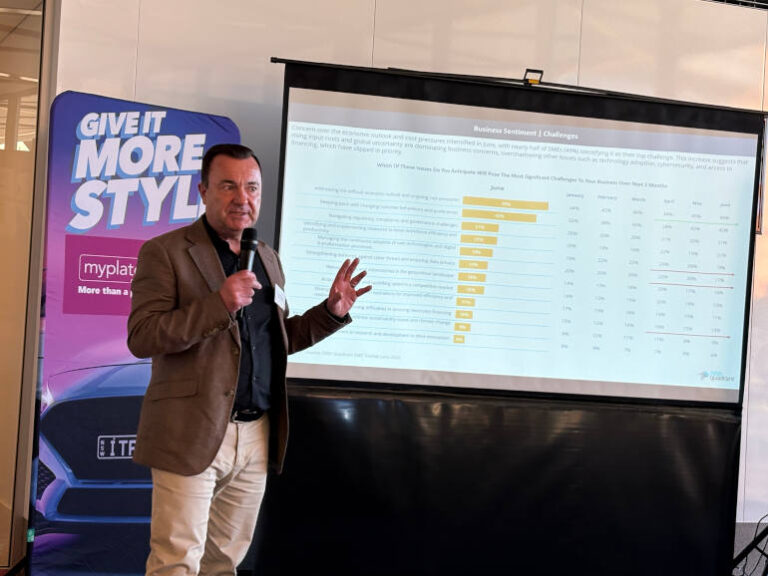
At the 2025 Myplates Industry Forum, Dr Steve Nuttall, Strategy and Insights Director at Fifth Quadrant, delivered a clear message to fleet and automotive insiders: EV adoption may be trending upward, but businesses are firmly in a holding pattern due to declining revenue and fragile confidence.
While the conversation around EVs has shifted from hype to practical implementation, Nuttall’s research provided a sobering look at the challenges facing fleet operators today. His data revealed that electrification is still progressing, but in a climate of economic caution, the pace is not accelerating as once expected.
Business Confidence: “A level of nervousness”
According to Fifth Quadrant’s monthly SME tracker, sentiment among small and medium businesses has taken a significant dive. Nuttall said, “Twice in the last three years we’ve seen business sentiment drop below consumer sentiment.” This shift reflects a combination of declining revenues, cost pressures, and global uncertainty, with the net confidence figure for global conditions sitting at a worrying –38%, and business sentiment even lower at –50%.
“The market simply is more in that kind of holding pattern,” said Nuttall. “We’re trying to keep the ship afloat.”
This economic backdrop has direct implications for EV investment. As Nuttall noted, “SMEs are not borrowing to invest. It’s more like borrowing for cash flow.” In other words, the appetite for long-term strategic purchases—including EVs—is being stifled by the short-term need to survive.
Vehicle Purchasing Intentions: Softening across the board
Looking ahead to the next three months, Nuttall’s research showed a clear softening in intent to purchase both passenger and light commercial vehicles. While electric vehicle (EV) intent remains stronger than average, the overall number of businesses planning any major asset purchases is trending down.
“We can see that’s definitely trending down,” he said, with only 6% of businesses intending to increase staff in the next three months and 11% expecting a decrease—a clear signal of caution that is rippling through the economy.
EV Adoption: Progress, but not takeover
While the economic environment is a concern, Nuttall did acknowledge EVs are gaining traction—particularly through novated leasing.
Citing data from AFIA, he noted, “75% of the new business dollar value for EVs and hybrids has been driven by novated lease.” This figure reflects the strong influence of government tax incentives, but also raises questions about what will happen as those incentives are scaled back.
Importantly, Fifth Quadrant’s projections suggest EVs won’t dominate Australia’s roads anytime soon.
“Taking over the car park? Absolutely not… by 2030 maybe one in five vehicles could be an EV,” said Nuttall.
Instead, hybrid vehicles continue to act as the transitional bridge, with full EVs projected to overtake new petrol and diesel sales by 2028, but not make up the majority of the car parc until well into the next decade.
Fleet Charging Infrastructure: Avoiding public networks
One of the key insights from the fleet-specific data was the preference for private charging solutions. Nuttall shared findings from a previous survey of around 200 fleets conducted in partnership with AfMA and the NSW Government:
“Depot fleets can’t rely on public charging… they need operational continuity,” he said.
Instead, large fleets are investing in depot and potentially home-based charging to maintain efficiency. “They’re probably arguing they need about 15 charging stations for every two EVs added to the fleet,” he explained.
He also flagged a growing trend where charging strategy is part of a broader conversation about sustainability—touching on energy generation, storage, and grid integration.
What does this mean for Fleet Managers?
For Fleet Managers, the research confirms what many are already experiencing: planning for EV transition requires careful balancing of cost, risk, and operational readiness.
Four key takeaways emerged from Nuttall’s presentation:
- Caution is dominating – With business confidence dipping and revenues falling, the push toward electrification is slowing.
- Novated leasing is a key driver – Most EVs and hybrids in Australia are being financed this way, showing the power of tax-efficient funding models.
- Fleet EV growth is modest, not explosive – Larger fleets may be planning significant uptake, but the overall shift will be gradual.
- Infrastructure planning is critical – Charging needs to be built into the operational fabric of fleets, not left to public networks.
Looking ahead
Despite the current headwinds, Nuttall believes strategic fleet operators will still move forward.
“There’s a real balance right now between value and affordability,” he concluded. “We need to prepare for gradual electrification… and that means investment decisions today.”
For an industry searching for stability amid rising costs and uncertainty, the message was clear: EVs are here to stay—but getting there will be slower, more deliberate, and increasingly shaped by policy, infrastructure, and the real-world economics of fleet operation.