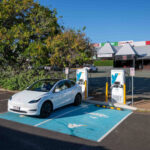
Origin has announced a collaboration with BYD and StarCharge to deliver Australia’s first Vehicle-to-Grid (V2G) enabled electric vehicle subscription. The trial, set to commence in 2026, will combine an EV subscription with a bi-directional charger and access to free home charging.
The bundle includes a BYD Atto 3, a StarCharge V2G Halo charger, and access to an Origin smart tariff that provides free charging at home for up to an estimated 24,000 kilometres per year. The offer will be limited to 50 customers, with expressions of interest now open.
Unlocking new value for drivers
Chau Le, General Manager, E-mobility at Origin, said the trial could transform how EV drivers interact with the energy grid.
“Vehicle-to-grid charging is a real game-changer that could turbocharge the EV market in Australia by allowing EV drivers to send electricity back to the grid from their car and get rewarded for that,” Le said.
The system will operate through Origin’s Virtual Power Plant, automating the charging and discharging process once the EV is plugged in. Eligible participants will receive free charging at home for every kilometre driven during their subscription.
According to the Electric Vehicle Council, an Australian driving 12,000km annually would typically spend around $500 charging an EV or $2,500 fuelling a petrol car. With Origin’s model, those costs could be eliminated.
Partnership driving innovation
The partnership between energy, automotive, and charging infrastructure providers highlights the wider role of EVs in the energy transition.
Sajid Hasan, Chief Product Officer at BYD Australia, said the project reflects the company’s broader mission:
“BYD is excited to partner with Origin to pioneer this technology in Australia to redefine what Electric Vehicle ownership means and to shed light that there is much more to an Electric Vehicle than just mobility.”
Kouki Xiang, CEO of StarCharge APAC, emphasised the shift in perspective for EVs:
“Vehicles are no longer just part of the transport network – with EVs and bi-directional charging technology, they’re becoming an active part of the energy network. Through V2G, every car becomes a mobile energy asset.”
Flexible and accessible option
Pricing for the subscription is expected to be under $800 per month after tax savings, with flexibility built in through Origin’s month-by-month structure. This means eligible drivers can take advantage of salary packaging and Fringe Benefits Tax exemptions without committing to long-term lease agreements.
For fleets and individuals, the potential cost savings and energy flexibility could reshape the economics of running electric vehicles in Australia.

- EVs are turning employees’ homes into fleet fuel stations
 For decades, fleet fuel management has been relatively straightforward. Give the driver a fuel card, let them visit a service station and receive an invoice detailing the transaction. Electric vehicles are changing that model because the organisation can suddenly be responsible for procuring the energy used to power its fleet — and some of that
 - Foton and Ampol Target Electric Truck ChargingFoton Mobility Distribution (FMD) and Ampol have signed a Memorandum of Understanding to explore charging solutions for electric truck fleets, with a focus on helping operators charge at depots, commercial hubs and public charging sites. The collaboration will investigate charging options across Ampol’s AmpCharge public network and private facilities for FMD’s fleet, logistics and business
- Ausgrid’s charging strategy goes well beyond the depotInstalling chargers at the depot might be the obvious starting point for fleet electrification. For Ausgrid, it wasn’t going to be enough. As the electricity network continues electrifying passenger vehicles, vans and trucks, it has developed a charging strategy designed around how employees actually use fleet vehicles. Speaking during the Fleet News Group Awards finalists
- Home Charging Enters a New Growth PhaseEvnex has passed 20,000 connected charger installations across Australia and New Zealand, with rapid growth reflecting the shift of home EV charging from an early-adopter product to mainstream infrastructure. The Christchurch-based manufacturer shipped its first charger in 2017. While reaching the first 10,000 installations took eight years, the next 10,000 were added in just nine
- Ampol’s $225 million Evie deal puts a new value on public EV chargingAmpol’s proposed $225 million acquisition of Evie Networks could prove to be a significant milestone for Australia’s EV charging sector, putting a substantial transaction value on a public charging network that was built well before electric vehicles became a mainstream consideration for Australian fleets. Ampol Energy has entered into an agreement to acquire 100% of