


Port Stephens Council is demonstrating that electric trucks are not just for large freight operators, with a customised Fuso eCanter proving its value in everyday local government operations.
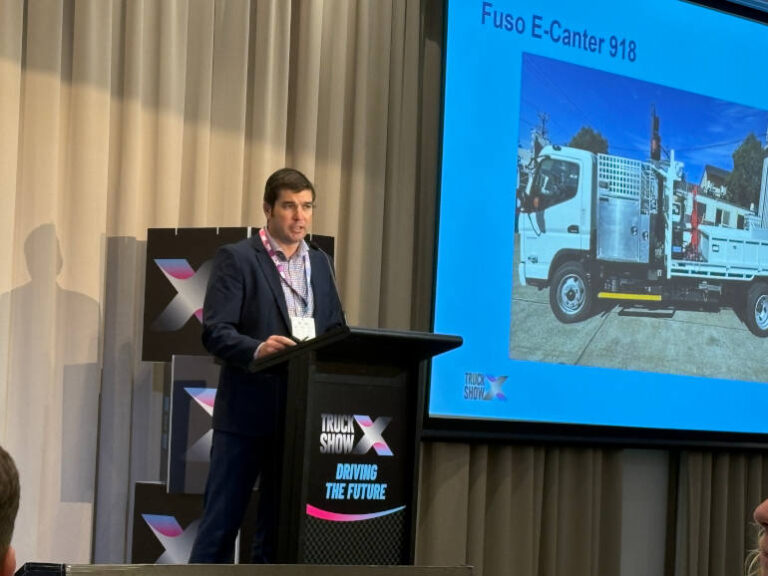
Speaking at TruckShowX in the Hunter Valley, Sean Carter, Fleet Supervisor at Port Stephens Council, shared the council’s experience deploying a Fuso eCanter 918 as part of its Public Place Cleaning Team.

The project provides a practical example for other councils considering electric vehicles, showing that a battery-electric truck can successfully replace a traditional diesel vehicle in a demanding municipal application while delivering operational and community benefits.
“We wanted, for our first truck, to have that three battery option, just so that we knew we had the range there, and we knew what it was capable of,” Carter explained.
The council selected the MY24 Fuso eCanter 918 with the extra-long wheelbase and the larger 127kWh battery pack, which uses three battery modules. The vehicle was also specified with an ePTO flange system to power specialised equipment fitted to the truck.
Rather than purchasing a standard electric truck, Port Stephens Council built a highly customised vehicle designed specifically for municipal services. The truck features a tipping body, a 300-litre pressure washer, a 500kg hydraulic crane, an arrow board and a message board.
“This particular truck is with our public place cleaning team,” said Carter. “They essentially get around Port Stephens LGA, they’re cleaning the public amenities, they clean the fish tables down, they’re doing the missed bin collections and park bin collections.”
Importantly, the truck was designed to look much like the rest of the council fleet.
“Probably the first thing you notice about this truck is it looks like every other council truck,” Carter said. “We wanted it so that we could blend it with the rest of our fleet.”
The vehicle’s gross vehicle mass was reduced to 7,995kg, allowing operation by drivers holding a Light Rigid (LR) licence. While this reduced the available payload, the truck still provides around 780kg of operational payload capacity, which suits the intended application.
One of the key learnings from the project has been the real-world range performance. Despite carrying specialised equipment and operating in a mixed urban and highway environment, the truck is consistently achieving around 260 kilometres of range.
“We’re finding that we’re getting about 260 kilometres,” Carter reported. “Port Stephens offers a bit of a mixed urban highway cycle because we are quite spread out.”
The council has also been pleasantly surprised by the minimal impact of auxiliary equipment on battery consumption.
“The most interesting thing that we got back from our operators so far is that there’s no significant reduction in range when they’re using any PTO,” Carter said. “They can go and operate that pressure washer for a couple of hours and they don’t seem to get much of a reduction in the range on the truck at all.”
Charging requirements have also proven manageable. While a near-full recharge from 20 per cent takes approximately eight hours, the truck’s daily duties mean it typically only requires around 90 to 105 minutes of charging each day.
Beyond emissions reduction, the council has discovered that lower noise levels are creating new operational opportunities.
“The noise of the truck’s been a big game changer for us,” Carter said. “Traditionally they couldn’t go down the foreshore and start emptying bins and running gurneys early in the morning, but now they’ve been able to do that much quieter.”
The success of the first vehicle has already prompted Port Stephens Council to order a second eCanter for its Nelson Bay operations team.
The council is also exploring whether the quieter operation of electric trucks could support changes to operating restrictions, including seeking approval to access its waste transfer station earlier than the current 6am heavy vehicle limit.
For local government Fleet Managers, the Port Stephens Council project provides a strong example of how electric trucks can be integrated into specialised fleet applications today. Rather than waiting for future technology, the council has shown that battery-electric trucks are already capable of performing a wide range of municipal tasks while delivering benefits in noise reduction, emissions reduction and community amenity.
The lesson for other councils is straightforward: identify suitable applications, start with a practical deployment and allow operational experience to guide future fleet decisions. As Port Stephens Council has demonstrated, electrification does not need to begin with an entire fleet transition—sometimes it starts with one truck doing an everyday job exceptionally well.