

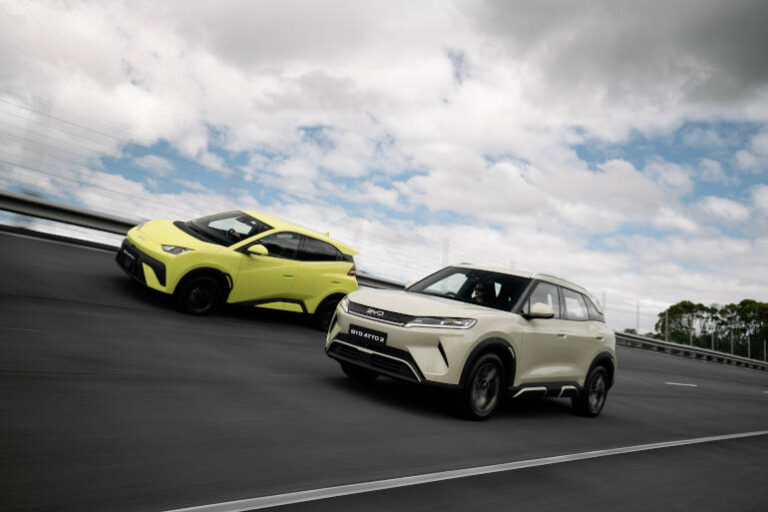
BYD has overtaken MG as Australia’s top-selling Chinese car brand, and in 2026, it aims to beat this year’s projected 50,000 deliveries in part by doubling its local fleet sales mix.
Speaking with Fleet News Group, BYD Australia chief operating officer Stephen Collins and chief product officer Sajid Hasan detailed not only a 2026 product offensive that centres the needs of fleets, but key back-of-house improvements designed to make the lives of fleet managers easier.
Although BYD started life in Australia as a full battery electric (BEV) specialist, it has broadened its lineup with the introduction of operator-friendly plug-in hybrid (PHEV) models around 18 months ago.
Factory-Backed Business Model Sees BYD Australia Refocus on Fleet Sales
Key to the shift in thinking on fleet business for BYD Australia was the shift to a factory-backed distribution and sales model for the brand, with the transition from previous distributor EVDirect occurring earlier in 2025.
Under EVDirect, fleet sales represented around five percent of BYD’s early sales volume in Australia, though fleets now represent one in ten BYD deliveries.
The goal for 2026 is to keep BYD’s aggressive sales trajectory on the up while doubling the share of fleet business via a mix of new models and improved fleet-centric metrics.
“We are already strong in the private sector [and] in novated leasing, but. We are investing in fleet. We are looking to grow into new channels and new product segments. For us, fleet is a huge opportunity,” said Collins.
While certain BYD models, and in particular the Shark 6 PHEV dual-cab ute, will account for a larger share of fleet sales, the overall fleet business target for 2026 is an aggressive one, according to Hasan:
“It will vary from model to model, but we are setting a target of 20 per cent fleet mix across the range for next year. It is coming off a low base, so it is a modest increase when you look at the absolute numbers.”
Advice for fleets
BYD Australia has set ambitious sales and fleet mix targets for 2026. While official fleet discounts have existed since August 2024, be on the lookout for deals as the Chinese brand looks to seize market share from familiar rivals.
Faster Parts Supply On The Way to Reduce Vehicle Off Road Time
While discounted pricing lowers the corporate cost of entry to BYD’s already generally fairly competitive model lineup, local brand chiefs have acknowledged that total cost of ownership and vehicle off road metrics are of crucial importance, as Mr Collins detailed:
“Total life cost is a big factor. Time off the road is a big factor. Technical and parts support are really important. These are the key parts, and if you want to be successful, you have to deliver [on these outcomes] every day.”
With an expanding lineup of models powered by efficient BEV and PHEV powertrains, BYD is confident that fleets will be capable of extracting TCO benefits from the vehicles—particularly where back-to-base charging is possible.
The Chinese brand has acknowledged that vehicle off road time has been affected in the past by inefficient parts supplies and logistics process and has plans in place for a shakeup in VOR metrics for fleets:
“We have just invested in a 20,000m2 parts warehouse in Melbourne, and we will be setting up more parts warehouses across the country to support the supply of parts,” said Collins.
“It doesn’t mean having a warehouse in every single state [but] we are making sure that we can deliver, at worst, overnight, if not the same day, in a capital city…we are resourcing with people and loan cars and we will do the same with parts and tech support.”
Takeaway for fleets
Newcomer brands—Chinese or otherwise—have tended to struggle with parts distribution in Australia to minimise VOR. BYD has acknowledged this problem, with plans underway to improve these key metrics into next year.
National Fleet Team Now Supplemented by Dealer Group Fleet Managers
With BYD’s product and aftersales teams setting up the building blocks to meet the goal of a doubling in fleet sales, the brand is also building out its fleet sales team and infrastructure with an eye on doing deals.
August saw the appointment of seasoned sales executive Marcus Walker as National Fleet Sales Manager for BYD Australia. The national fleet sales team is set to expand while product boss Sajid Hasan said BYD was working to better interlink national HQ with dealer group fleet managers.
“We are building a team around [Marcus]. Our dealer groups have dedicated fleet managers that are starting to link up with the national fleet manager and develop processes, engaging more fleet customers, understanding their needs, and entering more tenders.”
Hasan confirmed that getting BYD models onto additional federal, state, territory and local government authorised fleet lists would be a priority for the team in 2026 as the brand targets authorities and corporates looking to decarbonise their vehicle operations.
The fleet team is flush with existing and new BEV and PHEV metal, including the Shark 6 ute, the Atto BEV SUV lineup, forthcoming Sealion 5 midsize PHEV, and the $24K (plus on-road) Atto 1 electric supermini for fleets requiring urban-focussed solutions.
Implication for fleets
With a big expansion of fleet sales in 2026 a priority—including into government and other ESG-sensitive fleets—expect to see BYD models continue to be priced aggressively with five-star safety a priority.
Final Word: Fleets A Key Plank of BYD’s Future Sales Trajectory
Fleet Managers that are willing to look at alternatives to established brands should be aware that BYD is putting the building blocks in place to become a key player in government and corporate business.
It is still early days, but substantial local investments are underway in improving parts and service metrics to reduce downtime while an expanding product lineup offers highly competitive TCO metrics.
To achieve its planned doubling in fleet sales (while growing overall sales numbers) in 2026, BYD says it will:
- Continue to focus on affordable fleet-friendly BEV and PHEV models with five-star safety
- Build out a network of parts warehouses with overnight logistics, at least for capital city operators
- Provide discounts for fleet operators with at least 20 vehicles
- Enter more competitive tender processes, including for government contracts




