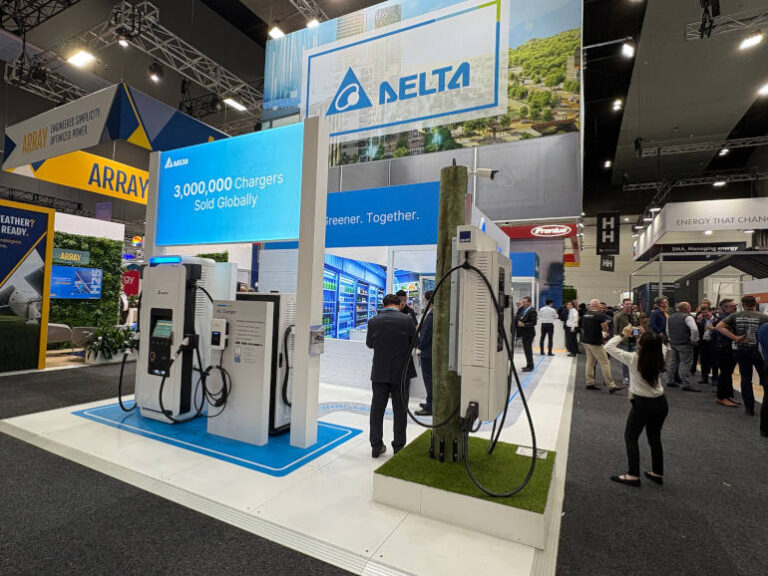
Australia’s kerbside charging landscape is undergoing a major shift. After years of councils trialling AC pole-mount chargers and low-speed public units, the market has quietly decided that AC isn’t enough. The next wave of kerbside charging will be DC fast charging, and Delta Electronics’ launch of Australia’s first pole-mounted 50 kW DC charger signals the start of this transition.
At All Energy 2025, the message from the industry was clear: AC is fine for slow top-ups, but DC is what delivers meaningful range in real-world urban environments.
As Delta Electronic’s EV specialist Matt Nolan explained, CPOs immediately saw the value when the product was shown to market.
“Why hasn’t someone done this sooner?” he said, noting that kerbside DC solves problems AC never could.
The Problem With AC Kerbside Charging
For years, councils have trialled AC chargers on street poles, power bollards and laneways. They’re cheap, easy to install and suitable for overnight dwell times. But in real life, most kerbside parking in Australia isn’t overnight—it’s regulated.
In high-density suburbs, drivers often park for just 1–2 hours. AC simply can’t deliver enough energy within that window.
A typical 7 kW AC charger adds:
- ~35–40 km of range over two hours (ideal conditions)
A 50 kW DC charger adds:
- ~150–200 km of range in the same time
- enough for a full day’s urban driving
- enough for ride-share, car-share and last-mile fleets
Nolan was blunt about the difference: “AC charge is easy, but the capacity is so small you wouldn’t be able to charge… in two hours you’d have very limited battery.”
When a driver gets only a small top-up from AC, they still need to find charging elsewhere—undermining the entire purpose of kerbside solutions. DC changes that completely.
Why DC Is the New Standard for Kerbside Charging
- It Works With Existing Two-Hour Parking Zones – Delta’s pole-mounted 50 kW DC charger can take an EV from 20% to 80% within typical 2P limits. This aligns perfectly with what Australian cities already enforce. Charging catches up to parking, not the other way around.
- It Delivers Real Usable Range – City-based fleets—couriers, trades, car-share, car rental, council vehicles—need predictable range recovery during short breaks.
- It Solves the “No Off-Street Parking” Barrier – A large share of Australia’s future EV owners will live in apartments or townhouses without driveways. AC kerbside helps, but DC kerbside empowers. A two-hour shop becomes a full recharge.
- It Avoids Costly Civil Works – AC pole-mount chargers are easy to install, but Delta’s DC pole-mount unit surprisingly isn’t far behind.
- Better Business Case for CPOs – DC kerbside units use more electricity in the same timeframe as AC, which improves utilisation and revenue.
How the Market Reached This Turning Point
Australia’s first wave of public EV charging was built on AC because it was cheap and simple. But the second wave—the one happening now—is driven by:
- higher EV adoption
- more affordable BEVs
- fleets transitioning
- councils dealing with apartment-rich suburbs
- DNSPs actively supporting pole-mount solutions
- government grants accelerating rollout
As a result, AC is shifting back to its original role:
- apartment buildings
- workplace day parking
- long-dwell destinations
- slow top-ups
DC is taking the lead on the street.
The Future: DC as the Default Kerbside Standard
In Europe, DC kerbside is already growing rapidly. Australia is following that path—just faster, thanks to the right timing.
Delta’s system is the first, but it won’t be the last. Other networks and DNSPs are now examining similar deployments. The combination of:
- low civil costs
- high charging speeds
- simple pole-mounted installation
- two-hour-zone alignment
makes DC the clear winner for urban areas.
Kerbside Charging 2.0 is here. And the days of relying on AC alone are behind us.
A New Era for Urban EV Use
The arrival of DC kerbside charging will:
- accelerate private EV uptake
- support the next generation of small fleet EVs
- enable take-home vehicles for workers without driveways
- empower councils to electrify car-share, waste and community fleets
- reduce the time drivers spend searching for chargers
It makes EVs more convenient for city dwellers, more viable for commercial operators, and more profitable for CPOs.
As Nolan summed up at All Energy: “We need lots of this… and the technology finally matches what the market needs.”
DC kerbside charging isn’t a future concept. It’s rolling out now, and it’s going to reshape how Australian cities charge electric vehicles over the next decade.
- Parramatta found a simple way to tackle EV resistance
 Range anxiety isn’t always solved with another spreadsheet. Sometimes you need to hand someone the keys. That’s one of the lessons from City of Parramatta’s fleet electrification program, where an EV drive week has become an important tool for building employee support for the transition. Speaking at Everything Electric Sydney during a panel featuring finalists
 - Ausgrid’s charging strategy goes well beyond the depotInstalling chargers at the depot might be the obvious starting point for fleet electrification. For Ausgrid, it wasn’t going to be enough. As the electricity network continues electrifying passenger vehicles, vans and trucks, it has developed a charging strategy designed around how employees actually use fleet vehicles. Speaking during the Fleet News Group Awards finalists
- For Allianz, EVs are now business as usualFor many organisations, fleet electrification still means pilots, trials and discussions about what might happen next. At Allianz, the conversation has moved on. After starting its transition with a small pilot of 12 vehicles two years ago, the insurer has reached the point where electric vehicles are becoming part of its normal fleet replacement process.
- A Charger That Powers Up Isn’t Finished: Why Commissioning Matters for Fleet EV ChargingAn EV charger can be installed, connected and apparently operating — and the charging system can still be wrong. That is one of the more important lessons from the Local Council EV Integration Project involving Wyndham, Brimbank and Moonee Valley councils. As fleet charging installations become larger, depots are adding not only chargers but load
- How to Install EV Charging Without Shutting Down the DepotBuying electric vehicles may be the visible part of fleet electrification, but much of the hard work can happen underground. Trenching, conduits, electrical upgrades, switchboards, charger foundations, communications, traffic management and electrical shutdowns all need to be completed while the depot continues doing its normal job. Experience from the Local Council EV Integration Project involving