


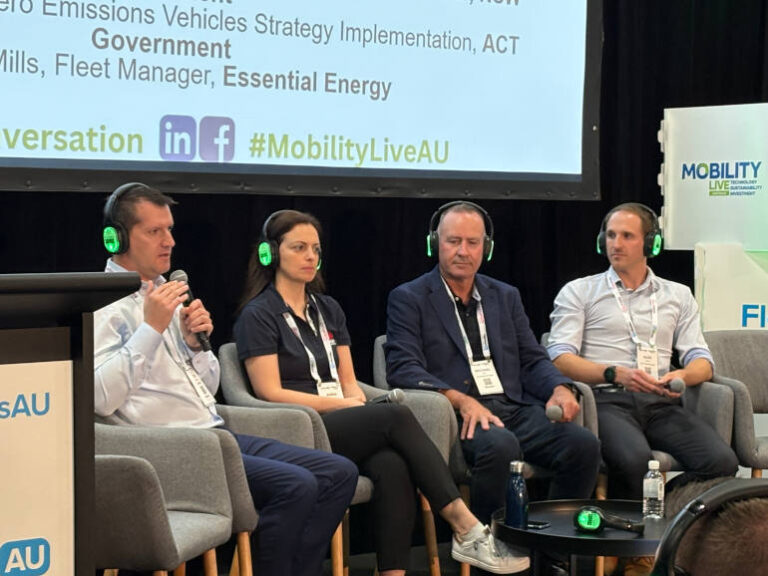
Across Australia, the fleet electrification landscape is no longer theoretical—it’s taking shape on the ground. At Mobility Live 2025, four of the nation’s most progressive organisations shared where they stand on their journey to zero-emission fleets: Ausgrid, Essential Energy, the NSW Government, and the ACT Government.
Ausgrid
Fleet Engineering and Strategy Manager Tim Kynoch said the utility had “a company-wide mandate to electrify as much of the fleet as possible.” Out of around 2,200 assets, Ausgrid now operates 130 electric passenger vehicles, is trialling light-commercial and heavy vehicles, and has installed 150 chargers across depots—mixing AC and fast-DC units. “EV is really hard,” he admitted, but added that the trials are yielding valuable operational lessons.
ACT Government
Director of Zero Emissions Vehicles Strategy Implementation Alex Killeen explained that Canberra began its transition in 2019 with clear targets and has already electrified around 75 per cent of its 600-vehicle fleet, supported by more than 600 load-managed chargers. “We had to do it through COVID,” Killeen said, recalling the early scramble to install infrastructure before vehicles arrived. “We’re now at a comfortable point where infrastructure is there first, giving our fleet managers confidence to make the switch.”
Essential Energy
Fleet Manager Michael Mills described a regional network of 3,500 assets, from utes to prime movers. “We’ve touched on around 60 EVs so far,” he said, “predominantly passenger vehicles.” The company has installed 90 chargers and already achieved a 9 per cent reduction in fleet emissions between FY24 and FY25. Heavy-vehicle pilots—including a Volvo prime mover and a Ford F-150 Lightning—are expanding experience beyond light duty.
NSW Government
Anna Martinis, Manager – Electric Fleets and EV Integration at the Department of Climate Change, Energy, the Environment and Water, outlined the scale: “We have 12,000 passenger vehicles.” The NSW Government has committed to 50 per cent EV procurement by 2026 and 100 per cent by 2030.
She explained that the past few years have focused on a pilot phase—trialling vehicles and installing initial depot infrastructure to prepare departments for the broader rollout starting this financial year.
Importantly, Martinis noted that the Government’s work extends beyond its own fleet.
“We also have a number of programs that support corporate fleets and local government fleets. We have incentives supporting vehicle procurement and also charging infrastructure.” Those programs have already helped fund more than 5,000 EVs and 2,000 chargers, alongside a rapidly growing public-charging network of 4,000 points across NSW.
Common themes
All four organisations emphasise that early pilots, data, and learning-by-doing are critical. “Start small, scale up,” Kynoch advised. Whether tackling grid constraints in rural depots or balancing policy ambition with real-world logistics, the leaders agreed that Australia’s fleet electrification effort has moved beyond experimentation into structured implementation.