


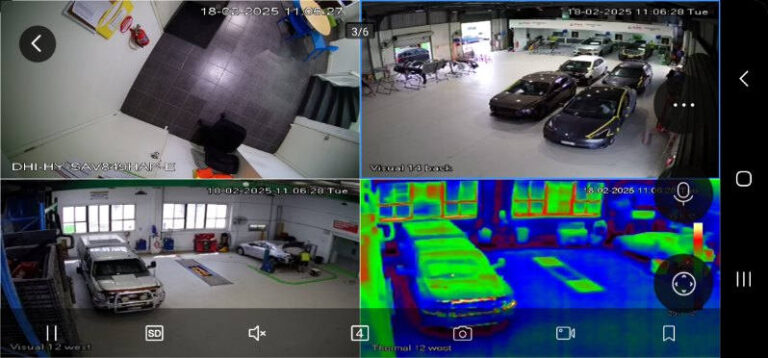
Insurers are increasingly requiring thermal imaging scans for businesses seeking cover for electrical and battery fires, forcing small businesses to seek cost-effective, yet compliant, solutions.
One local business did just that by finding a solution in Dahua Technology, a global leader in video-centric AIoT solutions, with a comprehensive range of advanced thermal imaging cameras designed specifically for early fire detection and real-time monitoring.
EV-repair owner Chris Agnew, who operates Somerville Smash Repairs on the Gold Coast, first installed the system to ensure the business would be covered should there be a fire on the business premises.
Mr Agnew says lithium-ion batteries present a unique fire risk that requires proper management plans to ensure worker safety and compliance with new insurance standards.
“We’ve done additional training and recently installed thermal cameras around the workshop to ensure we’re as protected as we can be—from both a safety and an insurance perspective,” said Mr. Agnew.
“We’re a family-run business with over 35 staff, so keeping staff safe means keeping my family safe.”
The devices work seamlessly together to automatically alert staff in the event of a temperature spike, which can be undetected to the naked eye, given the intricacies of what lies under the hood.
This system, like other Dahua offerings, is supported by AI-powered analytics and doubles as a security measure, making them a smarter solution for any business.
Industry expert David Davids, who operates an installation business in Queensland, says insurance companies have turned this product from luxury to necessity.
“Insurance companies have increasingly required thermal scans to insure businesses, as our world becomes more reliant on electrical infrastructure,” said Mr. Davids.
“I know first-hand of businesses who had their claims rejected, because they did not have thermal cameras installed. Since then, I’ve installed hundreds of these safety devices across Queensland.
“I would strongly encourage anyone that holds EVs, or other forms of lithium-ion batteries, to check with their insurance provider. Otherwise, you may find that in the case of an electrical fault, your business may not be covered.”
Chris Dalton, Director for Insurance Brokers Australia, says the thermal imaging requirement is a basic standard for businesses, to ensure their safety and compliance practices are keeping pace with the rise in electric vehicles (EVs) on the road.
“I’ve dealt with claims for fire damage originating from electric vehicle batteries, where having thermal scans or imaging allowed for an easier claim process,” said Mr Dalton.
Despite this risk, the demand for electric vehicles has continued to grow in Queensland, with 54,900 new electric vehicles registered just in 2024
Furthermore, the Queensland Government is on track to replace all eligible government passenger vehicles with EVs by 2026, with over 1,400 EVs currently on the road.
The rise of these vehicles is part of the state’s efforts towards being more environmentally friendly, considering that in 2022, transport emissions made up 17% of Queensland’s total greenhouse gas emissions.