


Precast concrete foundations could eliminate one of the most overlooked delays in EV charger installations.
The rapid expansion of electric vehicle charging infrastructure across Australia is creating demand for faster, more efficient installation methods. While much attention is focused on chargers, software and grid connections, one company is tackling a much simpler challenge – the concrete foundation beneath every charging station.
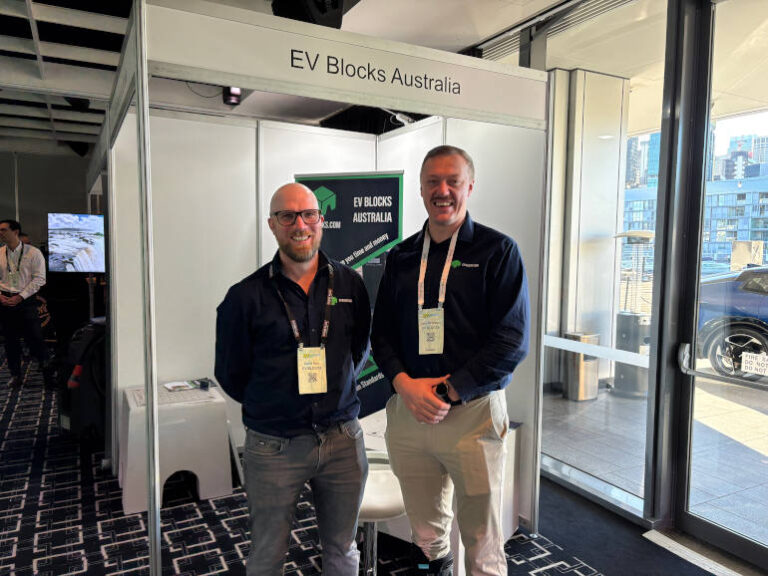
Speaking with Fleet EV News at the EV Infrastructure Summit in Sydney, EV Blocks Australia Sales Director Colin McGregor explained how the company’s precast concrete footing system is designed to replace traditional poured-in-place concrete foundations and simplify charger installations.

Building EV infrastructure differently
EV Blocks Australia supplies precast concrete foundations specifically designed for both AC and DC electric vehicle chargers. Instead of engaging concrete contractors, waiting for concrete to be poured and cured, installers receive a ready-made footing that can simply be positioned in the ground.
“It’s a precast concrete footing specifically marketed for EV chargers, both AC and DC,” McGregor said.
“Our position in the market is pretty much trying to push out concrete poured in situ. People no longer need to engage concrete contractors and can pretty much bring a footing to site in a box, drop it in the ground and be ready to go.”
The approach has the potential to significantly reduce installation time. According to McGregor, depending on the size of the project, customers can install, commission and complete an EV charging site within a single day.
Reducing embedded carbon
The benefits extend beyond speed.
Because the concrete is manufactured in a controlled facility rather than mixed and poured on site, the installation process requires fewer site visits and less heavy equipment movement. EV Blocks Australia also offers customers the option of selecting lower-carbon concrete mixes for projects where sustainability targets are important.
“There is that environmental aspect to it as well,” McGregor explained.
“You’re not driving concrete trucks to site, so you have less embedded carbon, and you can opt for a more environmentally friendly concrete solution to further reduce the carbon footprint of an EV charging project.”
Designed for today’s chargers and tomorrow’s upgrades
One of the more practical advantages of the EV Blocks system is its focus on future-proofing charging infrastructure.
While different charger manufacturers use different mounting arrangements, the larger EV Blocks have been designed with bolt patterns compatible with multiple brands and models.
As charging technology evolves, site owners may be able to replace an existing charger without excavating or rebuilding the foundation.
“In three to five years it’s just a natural path that we’ll be installing higher output, physically bigger chargers,” McGregor said.
“All that means is you can take the charger off, put the lid in place temporarily until you’re ready to reinstall. It’s another way of future-proofing your site.”
Planning infrastructure before the chargers arrive
McGregor believes one of the biggest opportunities lies in new depots and commercial car parks where organisations know charging demand will increase over time.
Instead of installing chargers in stages and excavating the site multiple times, developers could install all foundations during the initial civil works and simply add chargers as required.
“Every single time you break ground it costs your project again,” he said.
“If you can install 20 blocks at once, ready for 20 chargers in the future, why would you install 10, then come back two or three years later and dig everything up again?
“The price of everything naturally goes up, so the project just continues to get more expensive. If you do it once and have as much infrastructure in the ground as possible, it just seems like a no-brainer.”
Challenging industry habits
For McGregor, the biggest challenge is not engineering but changing established practices.
Traditional concrete pads remain the default approach simply because that is how the industry has always operated.
“It’s just a habitual thing,” he said.
“Our aim is to get to the point where people ask, ‘How many EV Blocks do I buy?’ rather than ‘How many concrete pads do I pour?'”
As Australia’s charging network expands across fleet depots, workplaces and public locations, innovations like precast foundations demonstrate that improving EV infrastructure isn’t only about faster chargers or smarter software. Sometimes, the biggest gains come from rethinking what sits beneath them.
- Hyundai STARIA Load Electric brings diesel-like capability — at an EV price
 Hyundai has confirmed pricing and specifications for the 2027 STARIA Load Electric, and for Fleet Managers the numbers tell two quite different stories. On specification, Hyundai has produced an electric van that sits remarkably close to its diesel and hybrid siblings where commercial operators care most: payload, cargo capacity and usable daily range. On price,
 - The overlooked fleet emissions opportunity sitting underneath every vehicleFleet decarbonisation is often discussed in terms of vehicle replacement, charging infrastructure and alternative fuels. Bridgestone Australia says tyre selection, maintenance, retreading and better data can also help fleets reduce emissions and prepare for new reporting requirements. When fleet managers talk about reducing emissions, the conversation usually starts with vehicles. Electric vehicles, hybrid powertrains, charging
- Roev Seeks ACT Fleets for Government-Backed Electrification ProjectACT-based fleets are being invited to participate in a new government-backed project designed to test a more dynamic approach to fleet electrification planning, charging infrastructure and energy management. Roev and energy analytics specialist Elentar are recruiting 10–15 fleets for VANTAGE — Electrified Fleet Agent, a project supported by the ACT Government’s Energy Innovation Fund. The project
- Australia’s EV Boom Sets the Stage for Biggest Everything Electric YetAustralia’s rapidly growing electric vehicle market will take centre stage when Everything Electric returns to Sydney in September with more than 100 EV models and thousands of test drives available across three days. Running from 18–20 September at Sydney Showground, organisers expect more than 40,000 people to attend what is shaping up to be the
- Meet the 2026 Fleet of the Year finalistsThe finalists in the 2026 Fleet News Group Fleet of the Year Award demonstrate three very different approaches to fleet management excellence. Blacktown City Council, Ausgrid and Parkes Shire Council operate fleets with different asset profiles, geographic challenges and service requirements, but each has shown a high level of maturity in the way it manages