
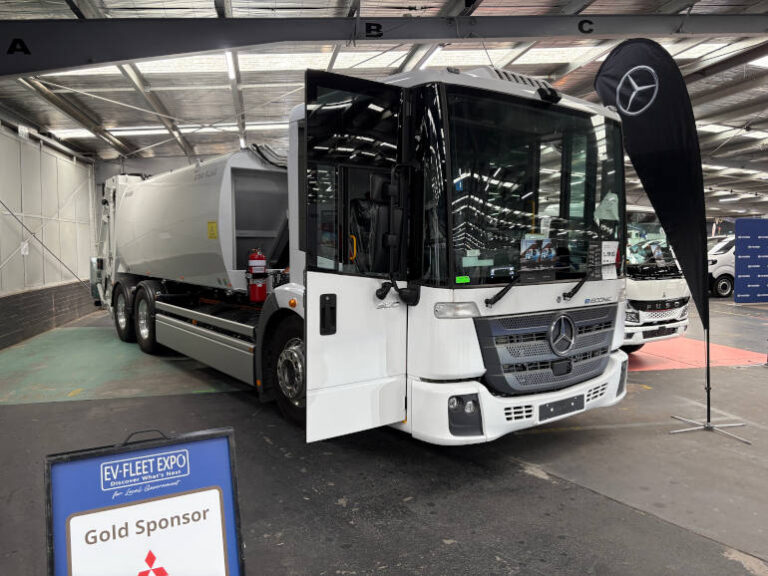
Daimler Truck Australia Pacific has marked a major milestone in its electric vehicle program, unveiling the first Mercedes-Benz eEconic in Australia fitted with a fully operational Bucher rear-loader waste body. After years of showing the low-entry cab at industry events, this is the first time the eEconic has been presented in a ready-to-work waste configuration — a turning point for councils and contractors preparing for zero-emission waste collection.
Romesh Rodrigo, Head of Regulatory Affairs and Emerging Mobility Sales at Daimler Truck Australia Pacific, said the truck arrived at the Fleet EV Expo for Local Government straight from Bucher’s workshop — with the build so fresh that the paperwork was still taped to the windscreen.
He described the moment as the transition from concept to reality. The eEconic is configured as a six-by-two waste collection platform, engineered specifically for dense urban environments and central business districts. Rodrigo noted the deep windscreen and low-entry layout provide visibility “unrivalled for inner-city operation,” and the crew-cab format pairs naturally with rear-loader duties.
A key breakthrough was integrating Bucher’s traditional hydraulic body with the factory electric power take-off (PTO) system. Rodrigo said Bucher had been “proactive and pragmatic” in working through the new interface requirements, ensuring the body performs exactly as operators expect. While Bucher was chosen for this first build, Daimler is simultaneously assembling another eEconic rear loader with Superior Pak — signalling strong engagement from Australia’s body-building sector.
Interest in the vehicle is already strong among major waste contractors. Rodrigo said the large national operators — Cleanaway, Remondis, Veolia and others — are leading early demand, with the first unit set to enter real-world testing with a major fleet customer. Although this will be the initial Australian deployment, he emphasised that the technology is mature, with eEconics already operating in waste applications across Europe for several years.
While rear-loader applications are the immediate focus, Rodrigo acknowledged that side-loader electrification remains technically challenging due to dual-control requirements and more complex body integration. He said Daimler’s approach is to prioritise fit-for-purpose deployments, learn from in-service data, and expand once the engineering and operational parameters are fully validated.
Beyond the electric drivetrain, the eEconic brings several safety and ergonomic advantages. Rodrigo highlighted the left-side concertina door, which allows crews to exit without the door swinging into traffic or obstacles — particularly valuable in laneways, alleyways and airport environments where space is tight. Air suspension front and rear enhances ride quality and supports the low-entry design that reduces operator fatigue during frequent stop-start collection cycles.
The arrival of a fully operational eEconic marks a significant step in the decarbonisation of waste fleets, particularly for councils where waste collection is one of the highest-emitting service categories. With Bucher and other body builders now proving compatibility, Daimler’s Australian rollout is moving from display stands to real-world conditions — and the industry is paying close attention.
More units are expected to follow as testing progresses, providing a pathway for councils and contractors seeking genuine zero-emission options that don’t compromise on daily productivity.
- bp pulse to Build 24-Bay EV Charging Hub at Melbourne Airport
 bp pulse has broken ground on its first large-scale electric vehicle (EV) charging hub in Australia, with a 24-bay site at Melbourne Airport planned for completion in 2026. Set within the Melbourne Airport precinct, the new charging hub will feature a mix of 150kW and 300kW chargers, two accessible bays, drive-through bays for larger vehicles,
 - Australia’s First Off-Site Electric Truck Charging Hub Opens in SydneyA new shared charging model for electric trucks has launched in Sydney, offering fleets access to high-capacity infrastructure without the need to build their own depot facilities. The collaboration between Foton Mobility Distribution (FMD) and Zenobē has delivered Australia’s first off-site electric truck charging hub in Mascot, designed to support the growing number of light-duty
- V2G for Fleets – The Next Big Opportunity, But Are Fleet Managers Ready?Vehicle-to-Grid technology could transform fleet economics. Here’s what you need to know. Electric vehicles are no longer just about replacing the fuel bowser with a charging cable. The next phase of fleet electrification is about turning those vehicles into energy assets, and Vehicle-to-Grid (V2G) technology is the key. With ARENA’s (Australian Renewable Energy Agency) recently
- NewVolt breaks ground on national fast charging network for electric trucksNewVolt today confirmed it is building Stage 1 of the NewVolt Network, a three-hub, open-access fast-charging network for electric trucks serving Melbourne’s major freight precincts. The announcement comes as the Australian Renewable Energy Agency (ARENA) formally announced $25.3 million in co-funding for the project in Canberra — backing that NewVolt says is already being put
- 1,700 New Chargers to Strengthen EV Infrastructure in New ZealandPublic charging infrastructure continues to expand across New Zealand, with ChargeNet announcing a major rollout supported by government co-investment. The company has secured $37.7 million through the Public EV Charging Infrastructure Loans programme, managed by National Infrastructure Funding and Financing, enabling the installation of more than 1,700 new charging points nationwide by 2030. ChargeNet will match the government