

Cummins used All-Energy Australia 2025 to make a decisive statement about its long-term strategic direction. Known globally for its diesel engines, the company is now positioning itself as a diversified energy solutions provider—combining storage, renewables integration, hydrogen technologies, and advanced microgrid controls alongside its traditional generator products.
For fleet operators, local government, utilities, mining and industrial organisations, the shift demonstrates a pragmatic approach to decarbonisation: reducing emissions without compromising reliability or operational uptime.
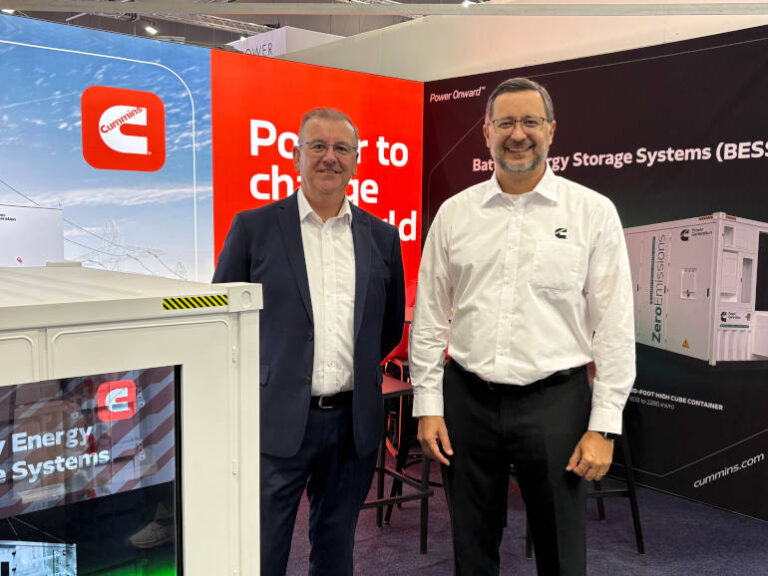
This direction was reinforced in conversations with Lucio Kroll, Senior Director – New Energy Solutions at Cummins Power Systems, and Craig Wilkins, Director & General Manager – Power Generation, Cummins Asia Pacific.
Destination Zero™: Strategic evolution backed by dedicated investment
Cummins’ Battery Energy Storage System (BESS) launch aligns with the company’s Destination Zero™ strategy—a roadmap guiding Cummins toward net-zero emissions across its global product portfolio.
Lucio noted that the transition is not new, but the momentum has accelerated:
“The battery energy storage system is well aligned at Cummins… because it is a zero-emission product. From the Power Generation perspective, the BESS supports the Cummins Destination Zero strategy.”
Several years ago, Cummins established Accelera, a standalone business unit focusing solely on emerging technologies including fuel cells, hydrogen production, and energy storage.
As Lucio explained:
“Cummins actually formed an entire business unit focused on these technologies… to attract the right talent with the right mindset for new energy. We need a separate business unit whose primary goal is developing and scaling this type of product.”
This structural change signals that Cummins is committed to the transition for the long term.
Broadening the brand beyond diesel
One of the biggest questions for customers is how a company synonymous with diesel can reposition itself in a low-emission environment.
Craig addressed this directly:
“In some markets we have a stronger share in diesel, but globally we do a lot in natural gas, hydrogen, and batteries… Diesel remains important in some applications, but the brand is about reliability, dependability and support—not just the fuel source.”
Rather than replacing diesel, Cummins is expanding the toolbox. Many customers will continue to need diesel generation—particularly in remote, high-duty or emergency applications—but now have options to integrate:
- renewable energy
- battery storage
- hydrogen engines
- microgrid controls
- hybrid systems combining diesel and storage
This mirrors the reality facing fleet buyers and infrastructure operators: the transition is multi-pathway, not all-or-nothing.
Why BESS matters: a practical bridge in the decarbonisation journey
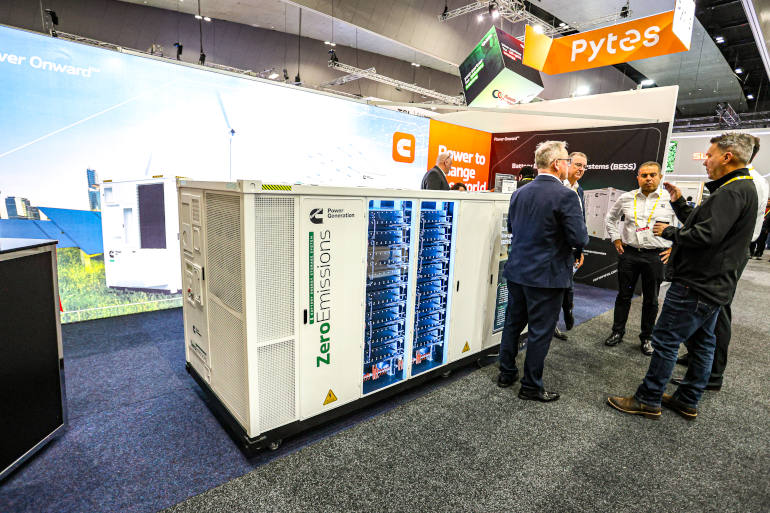
The BESS platform introduced at All-Energy Australia provides a strategic bridge for organisations wanting to cut emissions while protecting existing assets.
The system is available in six configurations from 100 kW/200 kWh up to 1 MW/2 MWh, housed in transportable ISO containers with plug-and-play integration. It features:
- LFP battery chemistry (stability and long cycle life)
- Liquid cooling for Australian heat
- Integrated fire suppression
- AC-output architecture
- Advanced microgrid control systems
Lucio described its role in Cummins’ broader transition:
“This launch brings Cummins’ trusted quality together with over a century of experience in power generation equipment… It’s a bridge technology to what’s going to come next.”
Craig reinforced why this product is arriving now:
“Our customers are telling us they want emission solutions. They want to integrate renewables. They still want the reliability of diesel generators, but they want to consume less diesel.”
The BESS enables exactly that—reducing diesel usage through peak shaving, renewable shifting, and hybrid operation.
Designed for the realities of the Australian market
Australia is a priority market for Cummins’ storage strategy.
Lucio highlighted its importance:
“Australia is number four globally in terms of market size and adoption rate. It is a strategic country for us.”
High solar penetration, remote industrial activity, and widespread off-grid infrastructure make storage systems not only attractive, but often essential.
Applications include:
- mining and resources
- utilities and microgrids
- remote communities
- fleet depots transitioning to EVs
- industrial sites wanting backup power
- local government operations in regional locations
The operating range of –20°C to +50°C and Cummins’ national service network were key design considerations.
Craig added:
“Our specialty today is behind the meter with commercial and industrial customers… mining, construction, remote communities. This is new for us, but it’s an extension of our product range.”
A synergy with Cummins’ existing generator base
One of Cummins’ strategic advantages is its large installed base of diesel and gas generators across Australia.
Lucio explained:
“If someone’s going to buy a Cummins genset and is also considering BESS, it is fairly easy to integrate.”
This is a major factor for fleet depots, heavy vehicle workshops, construction operations, and regional councils that already use Cummins equipment. They can build hybrid systems without replacing assets.
Craig emphasised the lifecycle support advantage:
“There’s plenty of people who can sell a battery… but it’s a matter of being able to manage it right from the start all the way to the end. That’s the unique part of what Cummins does.”
For buyers who prioritise reliability and uptime, this hybrid and service-centric model may be more appealing than standalone storage products.
A practical, staged approach to net zero
The combined insights from Lucio and Craig reflect a clear strategic direction:
- decarbonisation will take time
- multiple technologies will coexist
- battery storage enables a staged, low-risk transition
- Cummins will continue supporting diesel while expanding into clean energy
As Lucio summarised:
“It’s a near net-zero emission solution that supports Destination Zero… and a step toward what’s going to come next.”