


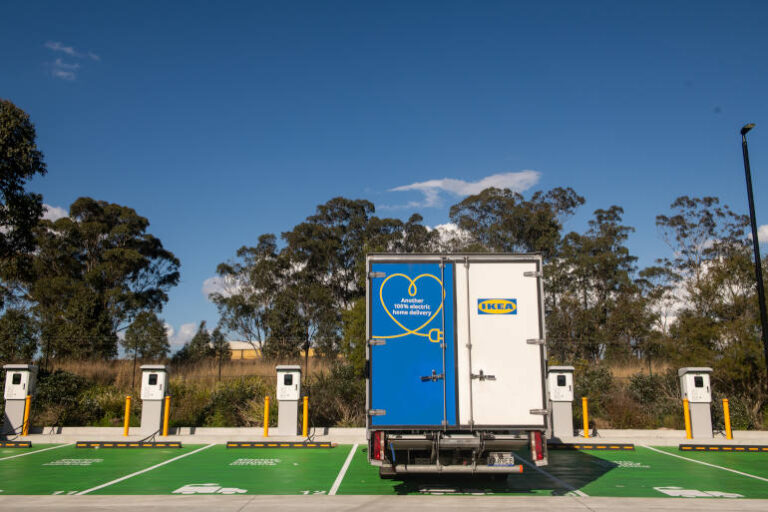
One of Australia’s largest electric delivery charging projects has shown that zero-emission logistics is no longer aspirational — it is operational, scalable and delivering measurable results for fleets.
JET Charge has completed a major national rollout in partnership with IKEA Australia, installing 59 EV chargers across seven sites to support the retailer’s transition to zero-emission deliveries. The infrastructure is already supporting more than 100 electric delivery vehicles, removing a key barrier that has slowed commercial EV adoption across Australia.
For Fleet Managers, Sustainability Managers and Finance Managers, the project provides a clear, real-world example of how charging infrastructure can be deployed across complex, multi-site operations to unlock fleet decarbonisation at scale.
Infrastructure, not vehicles, is the real challenge
While electric vans and trucks still represent a small share of commercial vehicle sales, the models available today can deliver immediate emissions reductions. The bigger constraint for many fleets has been charging infrastructure.
The Electric Vehicle Council has repeatedly identified depot-based charging and grid readiness as critical enablers for zero-emission logistics — and the areas where most organisations fall short.
The JET Charge and IKEA rollout addressed this challenge directly, delivering scalable charging infrastructure across seven operational locations: Tempe, Rhodes, Marsden Park, Sydney CDC, Canberra, Springvale and North Lakes, with Richmond and Logan planned next.
“This project proves that zero-emission logistics isn’t just possible – it’s scalable,” said Tim Washington, CEO and co-founder of JET Charge. “By building intelligent, fit-for-purpose infrastructure, we’ve given delivery partners the reliability they need on the road and IKEA the visibility to lead real emissions reductions across its supply chains. It’s a blueprint any retailer can follow.”
Built for fleet operations and commercial reality
Rather than focusing solely on charger numbers, the project was designed around how fleets actually operate.
Smart load management was implemented across all sites to manage energy constraints and future-proof capacity as electric delivery volumes grow. This reduces the risk of costly grid upgrades and supports staged fleet transitions.
The rollout also integrated a Chargefox billing system, allowing third-party delivery drivers to pay for charging sessions while reimbursing IKEA for electricity usage. This removes administrative friction and ensures transparent cost recovery — a key consideration for Finance Managers overseeing third-party delivery models.
“The financial investment in dedicated charging infrastructure will enable broader scale adoption of delivery vehicles by providing access for delivery drivers to recharge at sites owned by retailers and delivery companies,” Washington said.
Real progress towards zero-emission delivery
The results are already being seen on the road. As of October 2025, 83 per cent of IKEA deliveries in Australia were completed using zero-emission vehicles, with a target of 90 per cent by the end of 2025.
“Rolling out EV charging at scale is a critical step in achieving zero-emission delivery,” said Alexandra Kelly, IKEA Zero Emission Delivery Project Lead, Australia and New Zealand. “JET Charge’s infrastructure and implementation of the project, which spans the majority of our Australian delivery network, is already having a significant impact.”
For fleets weighing up their next steps, the lesson is clear: vehicle technology is ready. It is investment in smart, scalable charging infrastructure that now determines how fast zero-emission delivery can become business as usual.




