

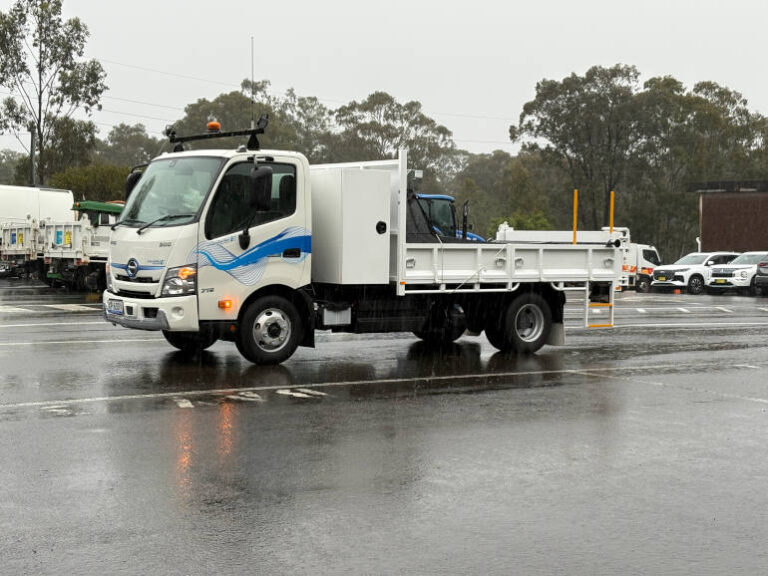
For many fleet operators, reducing emissions is now a core part of business strategy. While battery electric trucks attract the headlines, hybrid electric trucks like the Hino 300 Series Hybrid offer a proven and immediately deployable pathway to cut both fuel use and emissions.
Emissions reductions without infrastructure barriers
One of the key advantages of a hybrid truck is that it requires no new charging infrastructure. Fleets can purchase a hybrid today, operate it like a conventional diesel, and still achieve a verified reduction of up to 22% in fuel consumption and tailpipe emissions.
As Daniel Petrovski, Hino Australia’s Manager of Product Strategy, explained during dealer training:
“No recharging, no range limits, no infrastructure – anyone can just roll up, purchase a hybrid, and run it as a conventional vehicle. That’s where the 20% plus reduction in fuel use and emissions becomes so compelling.”
Real-world testing at Bathurst
Hino put its hybrid technology through its paces in Bathurst, running trucks in simulated delivery operations through town and regional routes. Across almost 300 kilometres, the hybrids demonstrated significant fuel savings that translated directly into lower CO₂ output.
Over a projected seven-year lifecycle, one truck would reduce emissions and operating costs equivalent to $38,000 in savings. For a 10-truck fleet, that scales to more than a quarter of a million dollars in cost reductions – and a substantial cut in emissions.
Matching the right truck to the right job
Hybrid trucks don’t suit every application. But in urban and regional delivery operations where stop-start driving allows the regenerative braking system to recharge the battery, the benefits are maximised.
Petrovski emphasised that the strongest results come when the truck is operated as intended:
“Our trucks aren’t driving around empty – they’re loaded 80% of the time. That’s when the hybrid performs at its best, delivering smoother shifts, lower fuel burn and more emissions saved.”
Extending the battery life
Unlike battery electric vehicles, the hybrid’s battery doesn’t cycle between empty and full charge. Instead, it operates between 30% and 70% state of charge, which significantly extends battery life. With more than 1,200 Hino hybrids already sold in Australia, none have yet required a battery replacement.
A stepping stone to zero emissions
For fleets under pressure to reduce their carbon footprint today, hybrid trucks provide a practical first step. They deliver immediate and measurable reductions in CO₂ without the capital costs, infrastructure planning, and operational risks that can come with early adoption of battery electric trucks.
Hybrid technology may not be the final destination in the emissions journey, but it is a critical bridge. It allows organisations to align transport operations with sustainability targets now, while preparing for a future that will eventually include a broader mix of electric and hydrogen trucks.